


Pitch Introduction
\p>The Fila Manila Shark Tank pitch is a compelling story of cultural representation and entrepreneurial grit. Founder Jake Deleon entered the Tank seeking an investment to bring the vibrant, underrepresented flavors of Filipino cuisine to every American household. His pitch was not just about selling sauces and spreads; it was about sharing his heritage and capitalizing on the growing trend of Filipino food in the United States. This detailed breakdown explores Jake’s journey, the intense negotiations with the Sharks, and the final deal that could change the landscape of ethnic foods in American grocery stores.Business Overview
Fila Manila is a packaged food company specializing in authentic Filipino-American flavors. The company was founded to address the significant lack of representation of Filipino cuisine in the mainstream American grocery market, despite it being one of the fastest-growing ethnic cuisines. Fila Manila offers a range of award-winning products, including cooking sauces, condiments, and spreads, all inspired by iconic Filipino dishes and ingredients.
The primary problem Fila Manila solves is the accessibility gap for Filipino flavors. Most consumers, including Filipino-Americans, struggle to find convenient, high-quality, and authentic Filipino products outside of specialty Asian markets. Fila Manila bridges this gap by offering products that are easy to use, delicious, and widely available in major retail chains.
The target market is twofold: the core Filipino-American community seeking authentic taste from home, and the broader American consumer base of food enthusiasts eager to explore new and exciting global flavors. The company’s unique selling proposition is its position as a first-mover in the CPG space for Filipino food, combined with its focus on clean-label, vegan, and gluten-free products that appeal to modern health-conscious consumers.
| Company Detail | Information |
|---|---|
| Company Name | Fila Manila |
| Founder | Jake Deleon |
| Industry | Food & Beverage (CPG) |
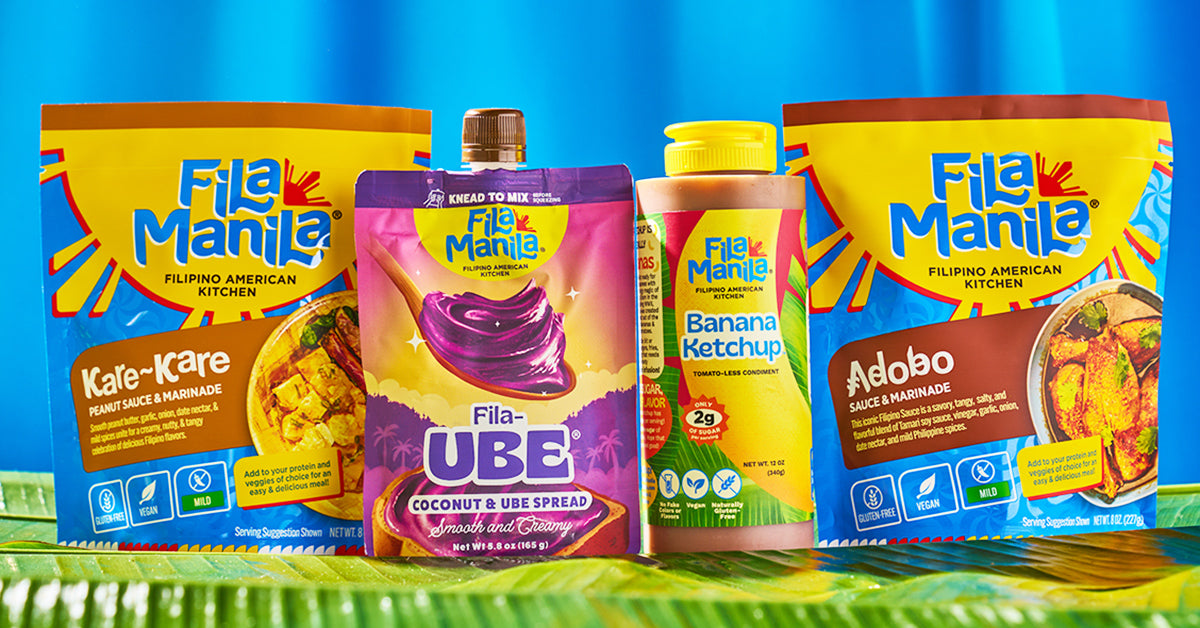
| Product Line | Banana Ketchup, Adobo Sauce, Kare Kare, Ube Spread |
| Dietary Info | Gluten-Free, Dairy-Free, Vegan |
About Founder’s
Jake Deleon is a first-generation Filipino-American immigrant, born in the Philippines and raised in New Jersey. His journey into the food business began early, helping his mother make and sell Filipino delicacies to friends and family for extra income. This early exposure instilled in him a deep love for food and entrepreneurship. Before founding Fila Manila, Jake built an impressive career in corporate food, working for giants like Procter & Gamble and Starbucks, where he helped develop and manage billion-dollar brands.
The idea for Fila Manila was born during the COVID-19 lockdowns. After reading an article about the significant contribution of Filipino healthcare workers on the front lines, he was struck by the paradox of their community’s importance versus the lack of cultural representation in grocery stores. Using his stimulus check and his immigrant grit, Jake began developing the first prototypes for Fila Manila in November 2020, turning his passion for his heritage into a viable business mission.
- First-generation Filipino-American immigrant
- Former brand manager at Procter & Gamble and Starbucks
- Started Fila Manila with his personal stimulus check in 2020
- Motivated by the lack of Filipino food representation in the US market
Shark’s and Founder’s QnA
Mark Cuban: You’re valuing your business at $5 million. That’s because you have a lot of sales, right?
Well, let me tell you a bit about the journey so far. My earliest memory in the food business was helping my mom make Filipino delicacies in the kitchen. We would then resell them to friends and family for extra income. Life is ironic because I ended up working for big food as a career. I enjoyed a career with Proctor and Gamble and Starbucks building billion-dollar brands. But like most crazy entrepreneurs, I love to build, I love to create, I love food. When the lockdowns happened, I saw an article that talked about in some areas of the US, 20% of the healthcare workforce fighting on the front lines of COVID-19 were Filipino. That was a mind-blowing moment for me. That’s where I came upon all these findings about this lack of representation in the market despite this growing trend of Filipino flavors. So during that period, in true immigrant grit, I used my stimulus check and I built the first prototypes of Fila Manila.
Daymond John: So November 2020 we launched into retail. My first store, first revenue for Fila Manila was $6,000. 2021 we expanded to $50,000. 2022 we did $400,000. Wait, you went from 50 to 400?
Yes.
Daymond John: Year to date?
Year to date we’re about 150, but I can explain, and we’re probably closing the year about 800,000. The big Y. Everything was in 12-ounce glass jars. Glass was very expensive. With the change to these non-glass formats, we moved our margin overnight to about 55% in general.
Kevin O’Leary: So what do they cost? What do you sell them for, and what do they cost you to make?
The pouches, we make it for about $1.60. We sell it for $3.33, and it retails for about $5.99.
Mark Cuban: Even if I like I really am excited about this, even if I trust that you’re going to get to $800,000, you’re at 150 to date. You’re imputing a valuation of $5 million in your company. It’s very rich.
How I did my valuation is that we’re the first mover in this space right now. Filipino is the fastest-growing cuisine in the US. Filipino is actually leading all that growth. We have 96% market share where Filipino cuisine is today is where Korean and Japanese were 20 years ago.
Lori Greiner: Let me push back a bit. Let’s put all this in context. So the real question becomes, where are you selling it? Because selling it at retail is very limiting for you because it’s hard to convey on shelf unless there’s a very large Filipino community. So how many stores are you in right now, and what percentage of your sales are online?
For sure, so we started off in Whole Foods one store. They expanded us into one region, and the product was doing well enough that they expanded us into four regions. This month, for last year, 90% of our sales were retail, 10% were online. Most of that came from Amazon.
Kevin O’Leary: The dish that’s missing here is the Nothing Burger because that’s what your sales are. It’s not worth $5 million, and you’ve got 150k in sales. I mean, we had 400,000 in sales last year.
Yeah.
Kevin O’Leary: But that’s worse. That’s worse. Think about it, you’re going down, not up.
Well, Kevin, this year is a transition year because we’re moving…
Daymond John: Because they’re moving what? Everybody says it’s a transition year. Look, I’m okay with transition years. Every one of us had one. But I see your biggest problem. One is that you did come in asking for 5% for $250,000, and you don’t have a lot of sales yet. And your second biggest problem is, for people to know what is Filipino food. I had no idea sitting here. And getting that out there is going to take a tremendous amount of time and energy. But I don’t hear you talking about a direct plan with how you’re going to get people that are not the Filipino community to understand or want to try Filipino food. And unfortunately, because I didn’t hear that, I’m out.
Before you go, can I share with you our plan?
Daymond John: So the plan we’re hoping to use the investment to create content to support exactly what you’re saying, showing food?
That’s the worst approach. I don’t think that there’s demand there. You’re not telling us that you know there’s so much demand and you had to change over and everything’s backordered and sold out. That’s not what I’m hearing. And so for those reasons, I’m out.
Kevin O’Leary: So I’m just looking at the numbers. I’m a numbers guy. 400,000 last year. We’re halfway through this year, you’re 150. You’ll be lucky to be flat this year. You are so not worth $5 million. I’m sorry, my friend, I’m out.
About the heartburn for it right now.
Mark Cuban: It’s gonna be hard for me. I got a really bad heartburn right now. It’s gonna be hard for me to have that passion to talk about it on something that I just can’t eat. I wouldn’t be able to be an advocate for it because I just can’t eat it. And unfortunately, I’m out.
I think as an entrepreneur, you are extraordinarily credible. I want to work with you.
Daniel Lubetzky: The most generous that I can get to is 20%. I know this is going to be a roller coaster ride, but I’d love to ride it with you.
Your valuation just got crushed. That’s a $1.25 million valuation. Daniel, it’s very kind of you. I mean, what you built with KIND is amazing.
Daniel Lubetzky: And with Kind…
I’m not hearing you say yes. And that’s… Yeah, what are you waiting for?
Daniel Lubetzky: I drew some inspiration. I drew some inspiration from Lori. So every season, I like to award my golden ticket to one of my favorite sharks, and it says royalty. So to help you mitigate some of the risks, would you consider, and this is open to other sharks as well, what if I were to give you a royalty of something like 5% of online sales until you recoup your initial investment of $250,000? And in exchange, we can do it for 5%.
I think to put our royalty structure in this, I think it’s very unhealthy. I don’t think…
Kevin O’Leary: Oh, not so fast. I’ll tell you, I’m interested all of a sudden. Let me make you another offer that you should consider. Okay, ready? Kevin likes the word royalty. Four sharks are out. Jake has an offer on the table from Daniel for his Filipino food company Fila Manila, but Kevin may have changed his mind when Jake mentioned a royalty. Chef Wonderful is now intrigued. Okay, I’ll do that royalty percentage, but I want to make back 500,000, so I double my money, and I’ll take 10% equity.
Why be greedy, Jacob? You open the door, a dung beetle walks right in. And you don’t want to answer the guy. That’s what you wanted right? Put the power of Chef Wonderful behind this brand. I like it.
Daniel Lubetzky: Well, Jacob, what do you think? That Kevin, thank you. I think you know, this brand represents the community we’re in from. And you know, as a community, we work too hard to…
I’m an honorary Filipino, you didn’t know that. So are you turning him down?
Daniel Lubetzky: I would like to hear Daniel’s answer to my proposal.
No, you’re the Rodney Dangerfield of Shark Tank, Kevin. I can’t do it, Jake. I looked at the numbers. I think I’m really stretching with the 1.2 million valuation, assuming your last year’s sales come back. And there’s just… What I would do is I would do it at 20%, but I would agree with you on setting certain set of challenges that if you meet them, you get 5% back. Is that your final offer? That’s Daniel, I be a full… I didn’t accept. You have a deal. Thank you so much.
Key Stats & Financials
The financials presented by Jake Deleon painted a picture of rapid growth followed by a strategic pivot. While the Sharks were initially concerned about the dip in year-to-date sales, Jake explained it was a result of a necessary transition from expensive glass jars to more cost-effective pouches, which significantly improved profit margins. This move was aimed at creating a more sustainable and scalable business model for the long term.
- Sales: $400,000 in 2022, projected $800,000 in 2023, with $150,000 YTD at the time of filming.
- Margins: Improved to ~55% after switching from glass to pouch packaging.
- Valuation: Initially requested a $5 million valuation, which was challenged by the Sharks.
- Investment Request: $250,000 for 5% equity.
- Use of Funds: Planned for creating marketing content to educate the broader market on Filipino flavors.
| Financial Metric | Figure |
|---|---|
| Original Ask | $250,000 for 5% equity |
| Original Valuation | $5,000,000 |
| Cost of Goods (Pouch) | $1.60 |
| Wholesale Price (Pouch) | $3.33 |
| Retail Price (Pouch) | $5.99 |
Business Potential and TAM
The business potential for Fila Manila is significant, anchored by the fact that Filipino cuisine is the fastest-growing ethnic food category in the United States. Jake positioned his company as a first-mover in a space similar to where Korean and Japanese cuisines were two decades ago, implying a massive runway for growth. The Total Addressable Market (TAM) includes not only the 4 million+ Filipino-Americans but also the tens of millions of adventurous American eaters who are constantly seeking new culinary experiences.
- Leveraging the growing popularity of Filipino culture and cuisine.
- Expansion into major retail chains beyond the current four regions of Whole Foods.
- Potential for product line extensions into other ready-to-eat Filipino meals.
- Strong appeal to health-conscious consumers with vegan and gluten-free options.
Fila Manila: Ideal Target Audience & Demographics
| Demographic | Details |
|---|---|
| Filipino-American Community | Core audience seeking authentic taste and convenience. |
| Foodies & Culinary Explorers | Individuals aged 25-45 interested in global cuisines. |
| Health-Conscious Consumers | Shoppers looking for gluten-free, vegan, and clean-label products. |
| Mainstream American Families | Broad target market educated through content marketing. |
Marketing and Distribution Strategy
Fila Manila’s distribution strategy has been heavily focused on retail, with 90% of sales coming from physical stores like Whole Foods, Target, and Stop & Shop in 25 states. The remaining 10% is driven by online sales, primarily through Amazon. The marketing strategy proposed during the pitch was to use the investment to create educational content, showing consumers how to use the products and introducing them to the flavors of Filipino cuisine. This content-first approach aims to overcome the awareness barrier and convert curious shoppers into loyal customers.
- Retail placement in major grocery chains to drive discovery and trial.
- E-commerce presence on Amazon to reach a wider national audience.
- Social media marketing, particularly on Instagram and TikTok, to showcase recipes.
- Future roadmap includes creating more ready-to-eat meal solutions.
Fila Manila Deal Outcome
After a tense negotiation that saw all other Sharks drop out, Jake Deleon accepted an offer from guest shark Daniel Lubetzky, founder of KIND Snacks. Kevin O’Leary attempted to jump back in with a royalty-heavy deal, but Jake stayed committed to his initial choice. Daniel’s offer was for $250,000 in exchange for 20% equity, a significant reduction from Jake’s initial 5% ask. This valued the company at $1.25 million, a quarter of the original $5 million valuation. The deal included a performance-based clause where Jake can earn back 5% of equity by meeting certain sales milestones, aligning the investor’s and founder’s interests for future growth.
| Deal Term | Details |
|---|---|
| Investor | Daniel Lubetzky |
| Investment Amount | $250,000 |
| Equity Given | 20% |
| Final Valuation | $1,250,000 |
| Performance Clause | 5% equity earn-back for hitting sales targets |
Fila Manila Post-Show Update
Following the airing of the Shark Tank episode, Fila Manila experienced a significant surge in consumer interest and online sales. The exposure from the show, combined with the strategic partnership with Daniel Lubetzky, has accelerated the company’s mission to bring Filipino flavors to the mainstream. The brand has continued to expand its retail footprint and is actively working on the content marketing strategy discussed in the Tank to educate new customers and build a loyal following beyond the Filipino-American community.
Business Analysis & Lessons
The Fila Manila Shark Tank pitch offers several valuable lessons for entrepreneurs. Firstly, the power of a strong, authentic narrative cannot be overstated. Jake’s personal story as a first-generation immigrant resonated deeply and gave the brand a soul that many CPG companies lack. Secondly, it highlights the critical importance of justifying your valuation with current, consistent sales data. While potential is exciting, investors like the Sharks focus on tangible numbers. Finally, the negotiation demonstrated the value of knowing your ideal investor and having the conviction to hold out for the right partner, as Jake did with Daniel Lubetzky, whose expertise in building a mission-driven food brand was invaluable.
- A compelling founder story can create a powerful emotional connection with investors.
- Be prepared to rigorously defend your valuation with solid financials and a clear plan.
- Market education is a significant cost and challenge for first-mover brands in new categories.
- Choosing the right strategic partner can be more valuable than a slightly better financial deal.