


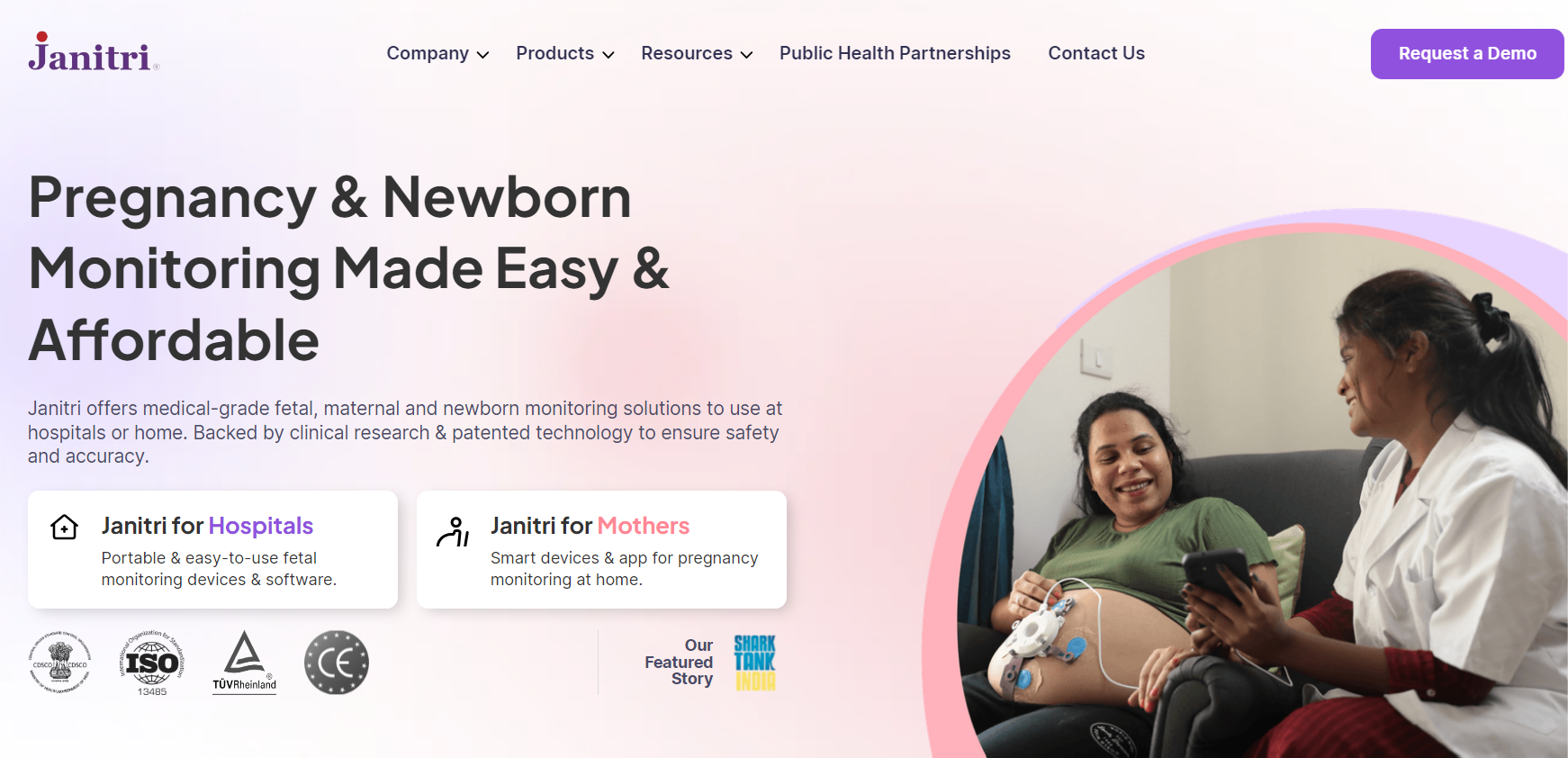

Janitri Shark Tank India: Medical Innovation Pitch
Janitri Shark Tank India appearance marked a watershed moment for maternal healthcare innovation in the Indian startup ecosystem. In a compelling presentation that moved both the Sharks and the audience, founder Arun Agarwal introduced a life-saving medical device designed to address India’s alarming maternal and infant mortality rates. The pitch stood out not just for its technological sophistication but for its profound social impact, showcasing how indigenous innovation can challenge global medical device monopolies while making quality healthcare accessible to millions of expectant mothers across the country.
Business Overview
Janitri operates at the intersection of biomedical engineering and artificial intelligence, developing wearable medical devices specifically designed for monitoring pregnant women and their unborn babies. The company’s flagship product ecosystem comprises three core components working in seamless integration to provide continuous, accurate, and affordable fetal monitoring solutions. Unlike traditional cardiotocography machines that cost lakhs of rupees and require constant manual intervention by nursing staff, Janitri’s solutions offer a digitized, automated approach that sends real-time data directly to doctors’ mobile devices, enabling timely clinical decisions regardless of the doctor’s physical location.
The primary problem Janitri addresses is the critical gap in maternal healthcare monitoring, particularly during the high-risk final trimester and labor period. In India, statistics reveal that 113 mothers die per 1 lakh live births, while 30 newborns per 1,000 face mortality during or immediately after delivery. Medical research indicates that over 80% of these deaths and complications can be prevented through proper monitoring during the last three months of pregnancy and labor. However, existing solutions are prohibitively expensive, non-portable, and require continuous manual adjustment by specialized nursing staff, making them inaccessible to smaller nursing homes and rural healthcare facilities.
| Company Attribute | Details |
|---|---|
| Legal Name | Janitri Innovations Private Limited |
| Founded | 2021 (5 years R&D prior) |
| Headquarters | Alwar, Rajasthan |
| Founder & CEO | Arun Agarwal |
| Industry | Medical Technology / HealthTech |
| Primary Device | KEYAR Fetal Monitoring Patch |
About Founder’s
Arun Agarwal hails from Alwar, Rajasthan, where he completed his schooling before pursuing his passion for technology and healthcare. He earned his B.Tech in Electronics from VIT Vellore, a prestigious technical institution in South India, where he first recognized the potential of technology to solve grassroots healthcare challenges. This realization led him to pursue a Masters in Biomedical Engineering, bridging the gap between electronics and medical science. His academic journey was deeply influenced by personal experiences, including stories of his grandmother who lost one of seven siblings to infant mortality, highlighting the harsh realities of healthcare access in previous generations.
Before diving full-time into entrepreneurship, Arun worked as a Patent Analyst specializing in Intellectual Property within the healthcare domain, giving him deep insights into global medical innovations and patent landscapes. During this period, he invested his free time visiting over 100 hospitals across India, observing live deliveries and C-sections to understand the practical challenges faced by medical professionals. This extensive ground research allowed him to identify specific pain points in existing fetal monitoring systems and design solutions that address real clinical needs rather than theoretical problems. His journey reflects a rare combination of technical expertise, clinical understanding, and social consciousness.
- B.Tech Electronics from VIT Vellore with Biomedical specialization
- Former Patent Analyst in healthcare intellectual property domain
- Conducted field research across 100+ hospitals in India
- Observed live childbirth procedures including C-sections personally
- Recipient of grants from Bill & Melinda Gates Foundation and international governments
Shark’s and Founder’s QnA
Namita Thapar:
Arun ji, welcome to Shark Tank. This product is very close to my heart because Emcure has a significant presence in gynecology and women healthcare, and I am myself a mother. But before we discuss the product, I want to understand your journey and background in detail.
Arun Agarwal:
I am from Alwar, Rajasthan, and completed my entire schooling there. After that, I got the opportunity to pursue B.Tech in Electronics from VIT Vellore, so I moved to South India. I always had a dream to solve grassroots level healthcare problems through technology, which is why I decided to pursue Masters in Biomedical Engineering. During my childhood, I heard many healthcare-related problems among friends and family. I learned that India’s infant and maternal mortality rates were extremely high 20 years ago. My grandmother’s stories particularly impacted me—she had seven siblings, and one of them died within one year of birth. These served as trigger points. When I started my B.Tech in Electronics, the dots connected, and I realized this is a massive global problem where technology has not yet reached adequately.
Namita Thapar:
Can you explain what exactly this product is and how it works in a clinical setting?
Arun Agarwal:
At Janitri, we have three products. The KEYAR patch, the DAKSH software, and NAVAM wearable which is currently in prototyping stage. NAVAM is a wearable device for fetal movement monitoring that mothers wear on a belt. When they feel the baby kick, they simply click the band to mark the timestamp. The KEYAR patch is a silicone and plastic patch that sticks to the pregnant woman’s belly and monitors four critical parameters: fetal heart rate, maternal heart rate, labor contractions, and fetal movement. This patch connects to the DAKSH mobile application which runs on any Android phone or tablet. The system includes consumables like five electrodes, double-sided medical tape, and skin exfoliation tape. You remove one side of the tape to attach to the patch and the other side to the skin. After adding patient data in the mobile app and connecting the cable, readings start immediately. The usage covers the last trimester—three months—and continues until delivery, including during labor.
Peyush Bansal:
When a woman is in labor pain, will she really remember to wear this device? It seems impractical during that stressful time.
Arun Agarwal:
Currently, we are selling B2B to hospitals and clinics, not directly to consumers for home use during labor. The device is applied by healthcare professionals during the final trimester and continues through delivery in institutional settings.
Aman Gupta:
Does any system already exist for this purpose in the market?
Arun Agarwal:
For the past 30-40 years, the market has had a device called Cardiotocography machine, commonly known as a fetal monitor. It uses two probes that must be positioned on the mother’s belly based on the unborn baby’s position, attached with belts. Nurses must re-position these probes every 30 minutes until delivery, which is a significant headache for them. These probes connect via wires to a large box that is not digital, producing thermal printouts. Doctors must physically visit that specific room to see the graph. Our solution sends data directly to the doctor’s phone, whether they are in conference, OPD, or anywhere else. Additionally, since our data is digital, we have implemented algorithms that automatically interpret the graph parameters, removing the subjectivity between experienced and inexperienced doctors’ assessments.
Peyush Bansal:
Do you have patents for this technology, and is anyone else globally working on similar solutions?
Arun Agarwal:
We have filed 12 patents, of which 4 are already granted. Globally, there are a couple of other startups working on similar journeys, but the traditional devices from big brands like Philips dominate the current market.
Vineeta Singh:
What is the cost difference between traditional devices and your solution?
Arun Agarwal:
Traditional devices from big brands like Philips start at ₹1.5 to ₹2 lakhs. Average brands cost around ₹1 lakh. Our KEYAR patch is priced at ₹29,000 MRP, and the DAKSH software has an annual subscription cost of ₹10,000.
Namita Thapar:
What are your current sales figures and monthly burn rate?
Arun Agarwal:
In the last financial year, we did sales of approximately ₹1.03 crore. Last month we did ₹10 lakhs. Our monthly burn is currently around ₹15 lakhs.
Peyush Bansal:
When did you actually start sales, and who has funded you so far?
Arun Agarwal:
We spent 5 years on R&D, clinical trials, and regulatory approvals. Sales started around March-April last year. We have been funded by the Bill & Melinda Gates Foundation, Government of Canada, and Government of Karnataka. These were all grants. To date, we have raised approximately ₹7 crore—50% through grants and 50% through equity.
Vineeta Singh:
At what valuation did you raise your equity rounds?
Arun Agarwal:
Our first seed round was in February 2020, pre-money, at a ₹15 crore valuation where we raised ₹2.35 crore. The same investors gave us ₹1.15 crore in April 2021 through convertible notes.
Namita Thapar:
I want to offer you ₹75 lakh for 5% equity, valuing you at ₹15 crore, plus ₹25 lakh debt. While there may be 200-300 hospitals, there are thousands of nursing homes in our country where pregnant women prefer to go. In this category, I am the queen, and you won’t find a better partner than me.
Arun Agarwal:
The ₹15 crore valuation was 2.5 years ago when we were pre-revenue and the risk was very high. We are currently raising a pre-Series A round at a ₹40 crore valuation, with ₹2.5 crore already committed. We are in the process now.
Namita Thapar:
I will double your valuation. Instead of ₹15 crore, I am giving you ₹30 crore valuation. This is final—₹60 lakh for 2% equity and ₹40 lakh debt.
Peyush Bansal:
I am forming my decision. I enjoyed learning that you are challenging global medical device players who have created monopolies with machines costing lakhs. This is Make in India and indigenous innovation. However, I am out because I believe Namita can help you better than I can.
Aman Gupta:
I really liked that you hustled for six years and pushed hard. I was ready to offer you a deal, but I believe Namita is the perfect shark for you, so I will leave it to her.
Peyush Bansal and Amit Jain:
We would like to come together. We offer ₹1 crore for 2.5% equity at a ₹40 crore valuation, conditional on you meeting your sales commitment. If you don’t achieve the committed sales, the equity becomes 5% at a ₹20 crore valuation.
Namita Thapar:
I am coming with two deals. First deal: ₹60 lakh for 2% at ₹30 crore valuation with ₹40 lakh debt, no conditions. Second deal: I will match Peyush and Amit’s offer exactly.
Arun Agarwal:
Deal done with Namita, the second one.
Key Stats & Financials
Janitri’s financial trajectory reflects the typical journey of deep-tech medical device startups, characterized by extended research and development phases followed by gradual commercial adoption. Having spent five years in product development, clinical trials, and regulatory approvals, the company entered the market with validated technology and grant support from prestigious international organizations. The current financial metrics indicate a growth-stage company poised for rapid scaling with the right strategic partnerships and capital injection.
- Annual Revenue (Last FY): ₹1.03 Crore with consistent month-on-month growth
- Monthly Revenue (Recent): ₹10 Lakhs showing steady traction in hospital adoption
- Monthly Burn Rate: ₹15 Lakhs primarily for operations and expansion
- Total Funding Raised: ₹7 Crore mix of grants and equity financing
- Valuation at Shark Tank: ₹40 Crore pre-money with conditional adjustment clauses
| Financial Parameter | Value |
|---|---|
| Original Ask | ₹1 Crore for 2.5% Equity |
| Final Deal | ₹1 Crore for 2.5% Equity (Conditional) |
| Pre-Money Valuation | ₹40 Crore |
| Conditional Valuation | ₹20 Crore (if targets missed) |
| Committed Next Year Revenue | ₹20 Crore Minimum |
| Current FY Target | ₹4 Crore |
Business Potential and TAM
The total addressable market for Janitri spans multiple segments including tertiary hospitals, nursing homes, gynecological clinics, and eventually direct-to-consumer home monitoring solutions. With India accounting for nearly 15% of global maternal deaths despite having only 18% of the world’s population, the clinical need is urgent and government-backed. The market extends beyond India to developing nations in Southeast Asia, Africa, and South America where similar infrastructure challenges exist. The company’s pricing strategy at ₹29,000 compared to competitors’ ₹1-2 lakhs creates a significant market opportunity in tier-2 and tier-3 cities where nursing homes dominate maternal care but cannot afford expensive imported equipment.
- Addressable market of 50,000+ nursing homes and mid-size hospitals in India
- Export opportunities in 70+ countries through distributor partnerships
- Government initiatives supporting Make in India medical devices
- Potential pivot to home-based monitoring for high-risk pregnancies
Janitri: Ideal Target Audience & Demographics
| Target Segment | Demographic Profile |
|---|---|
| Primary | Mid-size Nursing Homes (20-100 beds) |
| Secondary | Multi-specialty Hospitals with Maternity Wards |
| Tertiary | Individual Gynecologists & Private Clinics |
| Geographic Focus | Tier-2 and Tier-3 Cities in India |
| International | Southeast Asia and African Markets |
| End Users | Pregnant Women in Final Trimester (High-risk) |
Marketing and Distribution Strategy
Janitri currently operates on a B2B model, targeting healthcare institutions rather than individual consumers. The distribution strategy involves direct sales teams engaging with hospital administrators and gynecologists, coupled with medical representative networks familiar with obstetric care equipment. The company has initiated export activities to Southeast Asia, Africa, and South America, working with regional distributors who understand local regulatory requirements and clinical practices. Post Shark Tank, the strategy emphasizes leveraging Namita Thapar’s pharmaceutical network through Emcure to gain rapid access to gynecologists and nursing homes across India’s vast healthcare landscape.
- Direct B2B sales to hospitals and nursing home chains
- Medical representative networks for gynecology equipment
- Export partnerships for Southeast Asian and African markets
- Digital marketing targeting gynecologists and obstetricians
- Clinical demo programs with free trial periods for institutions
Janitri Deal Outcome
The negotiation on Shark Tank India Season 2 resulted in a unique conditional deal that reflected both the company’s potential and the execution risks inherent in medical device scale-up. Namita Thapar secured the investment after a competitive bidding process with Peyush Bansal and Amit Jain, ultimately matching their financial offer while bringing sector-specific expertise through her pharmaceutical giant Emcure. The deal structure includes a performance clause that aligns the founder’s incentives with investor expectations, ensuring that the ₹40 crore valuation is maintained only upon achieving ambitious but committed revenue targets.
| Deal Component | Details |
|---|---|
| Investor | Namita Thapar (Executive Director, Emcure Pharmaceuticals) |
| Investment Amount | ₹1 Crore |
| Equity Stake | 2.5% (Conditional) |
| Valuation | ₹40 Crore (Pre-Money) |
| Condition | If revenue targets missed, equity increases to 5% at ₹20 Cr valuation |
| Strategic Value | Access to Emcure’s gynecologist network and hospital relationships |
Janitri Post-Show Update
Following the Shark Tank India appearance, Janitri experienced an overwhelming response from hospitals, doctors, and potential distribution partners across the country. Founder Arun Agarwal revealed in post-show interviews that he specifically chose Namita Thapar over the joint offer from Peyush Bansal and Amit Jain because of her pharmaceutical background and existing presence in gynecological care through Emcure Pharmaceuticals. The company prioritized responding to incoming inquiries from medical institutions and scheduling demonstrations with gynecologists to capitalize on the show’s visibility. The team is actively working on expanding their product line to cover pre-pregnancy and post-pregnancy monitoring phases, moving beyond just labor and delivery monitoring to provide comprehensive maternal care solutions.
Business Analysis & Lessons
The Janitri pitch offers several compelling lessons for deep-tech and healthcare entrepreneurs navigating the Indian startup ecosystem. First, it demonstrates the importance of patient capital and grant funding for medical device startups, where regulatory approvals and clinical trials can consume years before revenue generation begins. Arun’s strategy of working as a patent analyst while researching the market allowed him to maintain financial stability while developing deep domain expertise. Second, the pitch highlights how strategic investor selection often outweighs valuation considerations—choosing Namita for her hospital network rather than accepting purely financial terms from other Sharks. Finally, the conditional deal structure provides a template for aligning founder-investor interests in high-potential but execution-heavy businesses, where milestones ensure that premium valuations are justified by actual performance metrics.
- Deep-tech ventures require 5-7 year R&D timelines before commercialization
- Grant funding from organizations like Gates Foundation validates technology and de-risks early stages
- Strategic investors with industry networks outweigh higher valuations from generalist investors
- Conditional term sheets align incentives while protecting investor downside
Pitch Conclusion
Janitri’s Shark Tank India journey represents a beacon of hope for indigenous medical innovation addressing critical healthcare gaps. By combining biomedical engineering with artificial intelligence, Arun Agarwal has created a solution that not only challenges global medical device monopolies but also makes life-saving technology accessible to smaller nursing homes across Bharat. The partnership with Namita Thapar positions the company to scale rapidly through established pharmaceutical distribution networks while maintaining focus on their mission of zero maternal and infant deaths. For aspiring entrepreneurs in the healthcare space, Janitri proves that with persistence, clinical validation, and the right strategic partnerships, Indian startups can create global-standard medical devices while solving pressing social challenges.