


Pitch Introduction
The Koparo Shark Tank India pitch introduced the sharks to a disruptive force in the ₹55,000 Crore Indian cleaning industry. Founder Simran Khara entered the tank during Season 3 with a vision to replace toxic, chemical-heavy household cleaners with naturally powered alternatives. By utilizing coconut-based surfactants, Koparo aims to provide a safe environment for children and pets without compromising on cleaning efficacy.
During the pitch, Simran highlighted a significant gap in the market: while the beauty industry has transitioned toward “clean” ingredients, the home care sector remains dominated by harsh chemicals like ammonia, bleach, and phosphates. With a background in top-tier organizations like McKinsey and Star TV, the founder presented a compelling business case that resonated with the sharks, ultimately leading to a high-stakes valuation deal.
Business Overview
Founded in 2020, Koparo is a Delhi-based D2C brand that specializes in sustainable home hygiene. The brand’s USP lies in its “coconut power” philosophy, using plant-based surfactants derived from copra to create lather and cleaning action. Unlike traditional FMCG giants that rely on synthetic chemicals, Koparo focuses on transparency and safety, catering to health-conscious urban households.
The company has successfully built a portfolio that extends beyond basic floor cleaners. Their product range includes specialty items designed for modern Indian homes, ensuring that every surface—from kitchen counters to delicate fabrics—is cleaned using non-toxic ingredients. The brand has delivered over 3 Lakh units across India within its first few years of operation.
Product Details
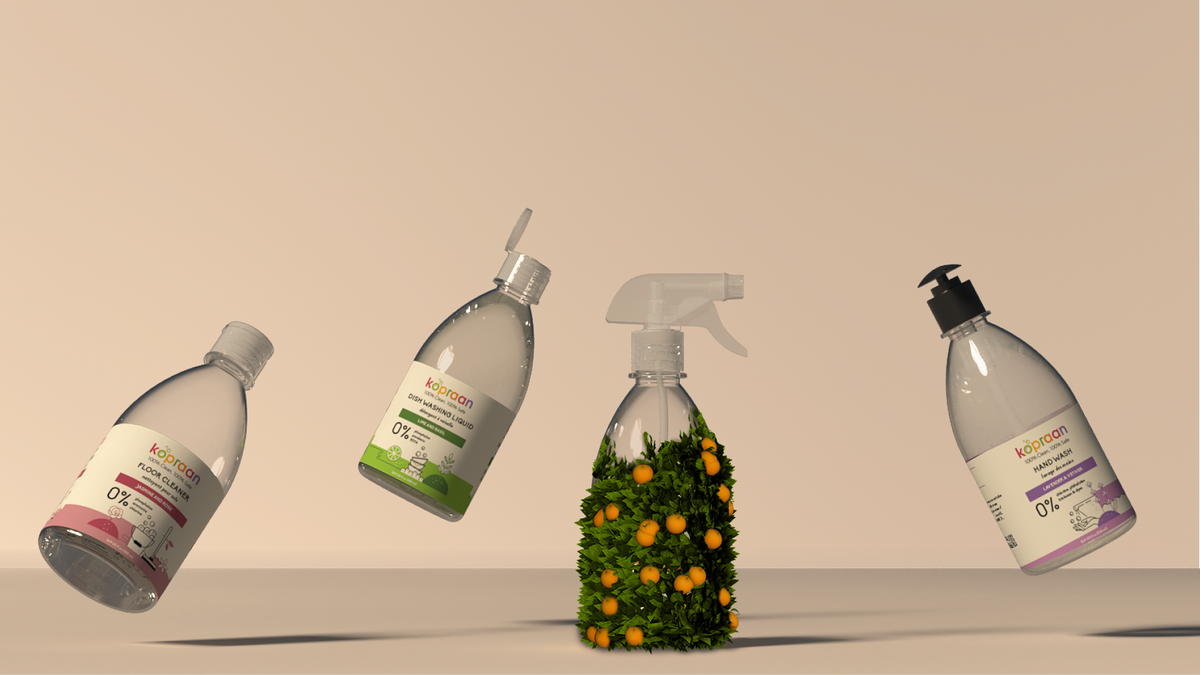
Koparo offers a comprehensive suite of cleaning solutions. Their hero product is the concentrated dishwashing liquid, which leverages coconut-based surfactants to remove grease effectively. Other notable products include PETA-certified laundry detergents, multipurpose surface cleaners, and a unique range of air fresheners that focus on fragrance without synthetic propellants.
The brand also focuses on cleaning accessories like microfiber cloths and brushes, positioning itself as a one-stop shop for sustainable home maintenance. All formulations are strictly child-safe and pet-safe, addressing the specific anxieties of parents and pet owners regarding chemical residues on floors and utensils.
Market Position
Koparo operates in the premium natural care segment, a “white space” currently ignored by massive FMCG players due to the high cost of raw materials. While traditional cleaners are priced for the masses, Koparo targets the top 10% of Indian consumers who are willing to pay a slight premium for health and environmental benefits.
Strategically, the founder has managed to keep the pricing competitive. For instance, their dishwash liquid is priced at ₹500 for a large pack, breaking down to approximately ₹9 per use, which is comparable to high-end traditional brands but offers superior safety profiles. This “premium yet accessible” strategy has allowed them to scale rapidly on platforms like Amazon and Big Basket.
| Business Detail | Information |
|---|---|
| Company Name | Koparo Clean |
| Founder | Simran Khara |
| Product Type | Sustainable Home Care |
| Price Range | ₹250 – ₹1200 |
| Primary Channel | D2C & E-commerce |
| Headquarters | Delhi, Delhi |
About Founder’s
Simran Khara, the force behind Koparo, possesses a stellar professional pedigree. She is an alumna of the London School of Economics (LSE) and ISB Hyderabad (2006 batch). Before venturing into entrepreneurship, Simran spent 15 years in high-level corporate roles, including a stint at McKinsey and serving as the CEO of Juggernaut Books. You can find more about her professional journey on her LinkedIn profile.
- Grew up in an Indian Army cantonment, fostering a disciplined approach to business.
- Extensive experience in revenue and monetization for Hindi GEC at Star TV.
- Inspired to start Koparo during the pandemic when she realized the toxicity of household cleaners.
- Developed the brand to ensure even her five-year-old daughter could safely help with cleaning.
Shark’s and Founder’s QnA
What was your background before starting Koparo?
I grew up in an Indian Army cantonment. My college path took me from Delhi University to LSE and ISB Hyderabad. I have 15 years of work experience, including McKinsey and Star TV, where I looked after revenue for Hindi GEC. Before Koparo, I was the CEO of Juggernaut Books.
How did you estimate the market size for this niche?
I used both top-down and bottom-up market sizing. The cleaning industry is a Rs 55,000 Crore market. I looked at the GDP, population, and sales price units. When the numbers from both approaches aligned, I became confident in the white space opportunity available for D2C brands.
What exactly is ‘Coconut Power’ in your products?
The base of every cleaning product is a surfactant, which is what creates the lather. We use a surfactant based on coconut or copra. Many medical studies show that traditional bleach or phosphates in detergents can trigger dermatitis or eye irritation. Our plant-based surfactants avoid these issues.
Aren’t you worried that FMCG giants will enter this space?
They have the distribution, but currently, the price point of natural cleaners is too high for their mass-market model. This gives us a window of three to five years to build a massive brand and establish consumer trust before they consider entering this trend as it becomes mainstream.
How much have you raised before coming to Shark Tank?
I raised two rounds. The first was in November 2021, where we raised ₹5.6 Crores at a valuation of ₹32 Crores. In February 2023, we raised ₹12 Crores at a valuation of ₹57 Crores. We currently have more than ₹10 Crores cash in the bank.
What are your current margins and marketing spend?
Our gross margin is 66%. After logistics and warehousing, the contribution margin is 38%. We currently spend about 33% to 34% on performance marketing, achieving a healthy ROAS while managing a burn of about ₹27 Lakhs per month.
Key Stats & Financials
At the time of the Koparo Shark Tank India pitch, the business was showing strong growth signals. The company had hit a monthly revenue run rate of ₹80 Lakhs, a significant jump from its previous year’s performance. The founder’s ability to maintain high gross margins while scaling on digital platforms was a major point of interest for the sharks.
Revenue and Profitability
- Last Month Sales: ₹80 Lakhs
- FY 2022-23 Revenue: ₹4.5 Crores
- FY 2023-24 Projected Revenue: ₹12 Crores
- Gross Margin: 66%
- Monthly Burn: ₹27 Lakhs
- Cash in Bank: Over ₹10 Crores
Financial Breakdown
| Metric | Amount / Value |
|---|---|
| Yearly Revenue (FY23) | ₹4.5 Crores |
| Projected Revenue (FY24) | ₹12 Crores |
| Requested Valuation | ₹70 Crores |
| Gross Margin | 66% | 38% |
| Monthly Burn | ₹27 Lakhs |
Business Potential and TAM
The business potential for Koparo is immense, given the shift in consumer sentiment toward health and sustainability. The Indian cleaning and household care market is valued at approximately ₹55,000 Crores. While the majority of this market is currently captured by synthetic, low-cost products, the “natural” and “eco-friendly” segment is the fastest-growing sub-sector. As awareness of respiratory issues and skin irritations linked to traditional cleaners grows, Koparo is perfectly positioned to capture the burgeoning middle-class demand for safer homes.
Koparo’s Total Addressable Market (TAM) isn’t just limited to the premium segment. By optimizing their supply chain and scaling production, they have the potential to move into the mid-market segment. The global natural cleaning market is projected to grow at a CAGR of 10%+, and India is expected to outpace this growth as urban consumers prioritize pet-safe and child-safe environments. The rise of quick commerce and specialized e-commerce platforms provides a low-friction distribution path to these high-intent customers.
Market Size Analysis
The ₹55,000 Crore cleaning industry is dominated by giants like HUL and P&G. However, the sustainable cleaning niche, while currently small, is expected to reach ₹2,000 Crores by 2027. Koparo’s goal to reach 10 lakh consumers in two years is a realistic target given the rapid digitalization of Indian households and the increasing penetration of premium D2C brands in Tier 1 and Tier 2 cities.
Growth Opportunities
- Offline Expansion: Moving beyond D2C into high-end retail chains like Reliance Signature and Nature’s Basket.
- B2B Partnerships: Supplying to eco-friendly hotels, pet cafes, and premium playschools that require non-toxic cleaning.
- Category Extension: Launching specialized cleaners for expensive gadgets, premium upholstery, and automotive interiors.
- Global Export: Leveraging India’s manufacturing base to export coconut-powered cleaners to international markets like the UAE and SE Asia.
Koparo: Ideal Target Audience & Demographics
| Demographic | Details |
|---|---|
| Primary Age Group | 28 – 45 Years |
| Secondary Age Group | 45 – 60 Years (Health conscious) |
| Interests | Sustainability, Parenting, Pet Care, Organic Living |
| Platform Preference | Instagram, Amazon, Big Basket |
| Geography | Tier 1 Cities (Mumbai, Delhi, Bangalore) |
| Buying Behavior | Subscription-based, Bulk buyers, Quality-first |
Marketing and Distribution Strategy
Koparo has employed a digital-first approach to reach its core audience. By focusing on storytelling that emphasizes the safety of children and pets, the brand has built a high level of trust. Their marketing doesn’t just sell a cleaner; it sells “peace of mind” for parents who worry about their children crawling on floors cleaned with harsh chemicals.
Customer Acquisition
The brand utilizes performance marketing on Meta and Google with a strong focus on ROAS. Currently, they spend about 33% of revenue on marketing. Their Customer Acquisition Cost (CAC) is optimized through a mix of influencer collaborations and educational content that highlights the hidden toxins in everyday household products.
Distribution Channels
- Own Website: Contributes 45% of total sales, allowing for direct customer relationship management.
- E-commerce Marketplaces: 28% of sales come from Amazon, where they are a top-rated brand in the natural cleaners category.
- Quick Commerce: Heavy presence on Blinkit, Zepto, and Big Basket to cater to immediate cleaning needs.
- Retail Partnerships: A national deal with Reliance Retail is set to significantly boost their offline footprint.
Social Media and Content Strategy
On social media, Koparo focuses on “clean-with-me” videos and educational reels about surfactants. They frequently partner with “mommy bloggers” and pet influencers to showcase the real-world application of their child-safe and pet-safe products. Their fragrance-led strategy also helps in creating sensory-rich content that differentiates them from the clinical marketing of traditional brands.
Koparo Shark Tank Deal Outcome
The negotiation for Koparo was intense but professional. While several sharks were impressed by Simran’s background and the brand’s metrics, Peyush Bansal was particularly complimentary, even offering to introduce the brand to his network. However, it was the digital-native expertise of Aman Gupta and Vineeta Singh that eventually sealed the deal.
| Shark | Offer Detail |
|---|---|
| Aman Gupta | Invested ₹35 Lakhs for 0.5% equity |
| Vineeta Singh | Invested ₹35 Lakhs for 0.5% equity |
| Peyush Bansal | Interested but did not join the final offer |
| Anupam Mittal | Out (Concerned about competition from FMCG giants) |
| Final Decision | ₹70 Lakhs for 1% Equity |
Koparo Post-Show Update
Since its appearance on the show, Koparo has experienced explosive growth. According to Indian Express, the company’s monthly revenue surged from ₹70 Lakhs to ₹4 Crores. This massive scale-up highlights the “Shark Tank effect” on high-quality D2C brands.
Furthermore, YourStory reported that Koparo raised an additional ₹5.2 Crores in funding from 4P Capital Partners, alongside the ₹70 Lakhs from Aman Gupta and Vineeta Singh. The company is now valued at ₹70 Crores and is on track to reach its goal of ₹50 Crore annual revenue within the next two years.
Business Analysis & Lessons
The success of the Koparo pitch can be attributed to the founder’s exceptional clarity and the brand’s healthy unit economics. Unlike many D2C startups that sacrifice margins for growth, Koparo maintained a 66% gross margin, which provided the necessary buffer for aggressive marketing. The “founder-product fit” was also evident, as Simran’s corporate background allowed her to speak the sharks’ language regarding market sizing and distribution.
For entrepreneurs, Koparo serves as a masterclass in identifying a “white space” within a crowded industry. By shifting the narrative from “cleanliness” to “safety,” they created a new value proposition that resonated emotionally with a specific demographic. Their disciplined approach to raising capital and managing burn while maintaining a strong cash position made them an easy investment choice for the sharks.
Key Takeaways
- Value Positioning: Identifying that safety (child/pet-safe) can command a higher premium than standard cleaning efficacy.
- Pedigree Matters: A strong professional background builds instant credibility and trust with sophisticated investors.
- Omnichannel Readiness: Having a balanced sales mix across D2C, marketplaces, and quick commerce reduces platform dependency.
- Data-Driven Pitch: Using top-down and bottom-up market sizing to prove the existence of an untapped opportunity.
Pitch Conclusion
Koparo’s journey on Shark Tank India Season 3 is a testament to the power of a well-executed D2C strategy in a traditional industry. By securing a ₹70 Lakh deal and later scaling to a ₹4 Crore monthly run rate, Simran Khara has proven that Indian consumers are ready for sustainable, premium home care. As the brand expands its offline presence, it remains a prime example of how modern brands can take on legacy FMCG giants through innovation and transparency.
If you enjoyed this breakdown, check out Go DESi, The Healthy Binge, and The Cinnamon Kitchen.
[faq_accordian]