


Pitch Introduction
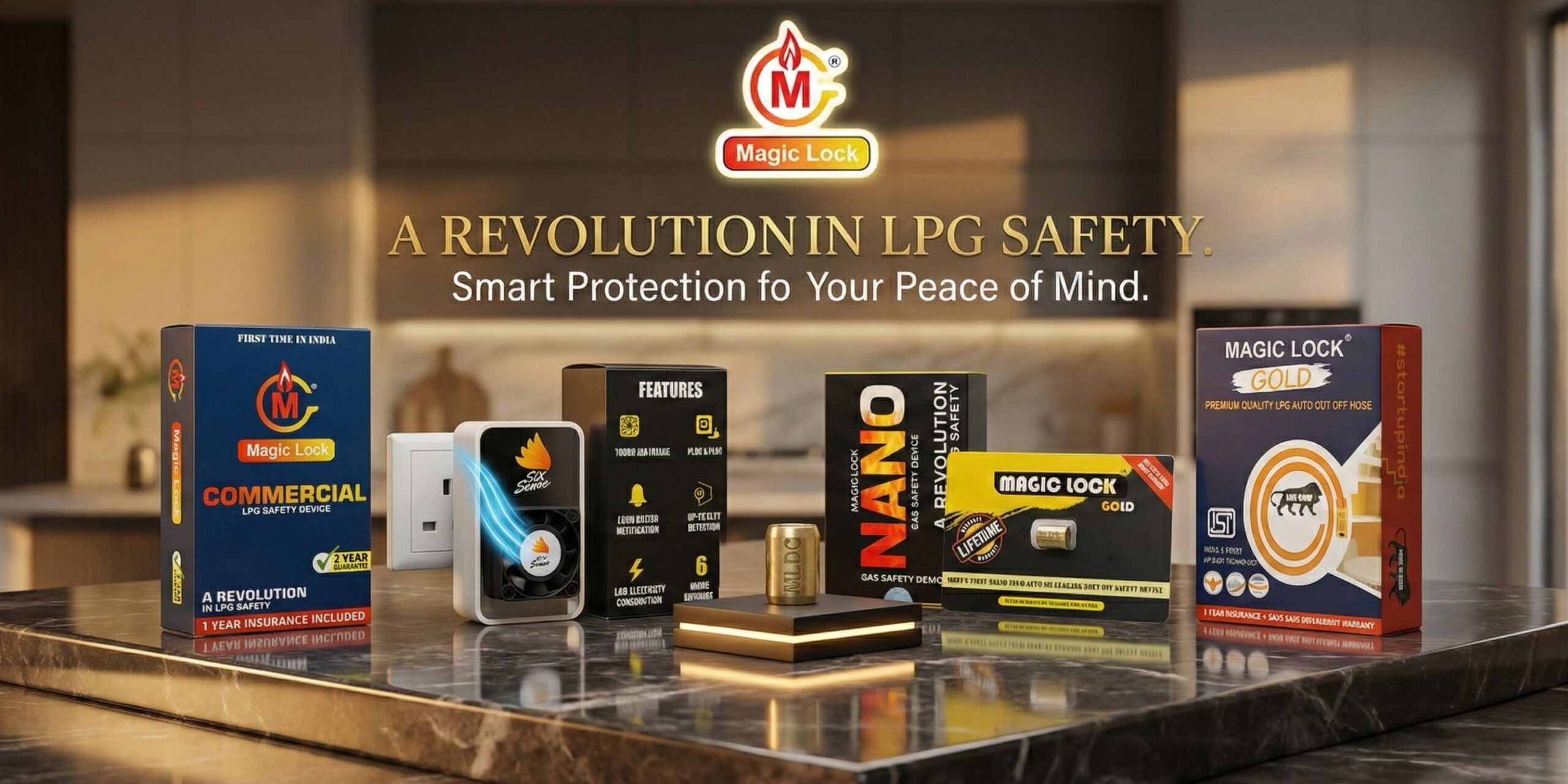
Magiclock Shark Tank India appearance marked one of the most intriguing hardware pitches in Season 1, featuring a specialized safety device designed to secure LPG cylinders in Indian households. The Mumbai-based founders entered the tank with high hopes and a patented product, seeking substantial investment to scale their innovative safety solution. Their pitch highlighted a genuine safety concern faced by millions of Indian families using LPG cylinders for cooking purposes.
Business Overview
Magiclock operates in the consumer hardware safety segment, offering a specialized locking mechanism designed specifically for domestic LPG cylinders. The product addresses multiple critical safety concerns including unauthorized usage prevention, child safety protection, and theft deterrence. Founded in 2019, the company developed a patented locking system that fits universally on standard Indian LPG cylinders, providing peace of mind to households concerned about gas safety and misuse.
The device serves as a physical barrier that prevents the gas regulator from being attached to the cylinder without proper authorization. This innovation targets both urban and rural households where LPG cylinder theft and unauthorized usage remain persistent issues. The founders identified a significant gap in the market where no standardized safety locks existed for domestic gas cylinders, despite the widespread adoption of LPG across Indian households.
| Company Attribute | Details |
|---|---|
| Product Name | Magiclock LPG Cylinder Lock |
| Founded | 2019 |
| Location | Mumbai, Maharashtra |
| Industry | Hardware Safety Devices |
| Patent Status | Patented Technology |
| Target Market | Domestic LPG Users |
About Founder’s
The Magiclock Shark Tank India pitch featured three male founders hailing from Mumbai, Maharashtra. These entrepreneurs brought diverse backgrounds in engineering and business development, combining technical expertise with market understanding to develop this specialized safety device. Their journey began in 2019 when they identified the pressing need for LPG cylinder security solutions in the Indian market, following several incidents of cylinder theft and safety concerns in residential areas.
The founding team spent considerable time researching LPG cylinder mechanisms, safety standards, and user behavior before finalizing their patented design. Their middle-aged demographic gave them practical insights into household safety concerns, allowing them to create a product that addressed real-world problems faced by Indian families. The team bootstrapped their initial operations, investing personal savings into product development and patent filings before seeking external investment on Shark Tank India.
- Three co-founders with engineering and business backgrounds
- Bootstrapped operations since 2019
- Mumbai-based manufacturing and operations
- Holds patent for LPG cylinder locking mechanism
- Combined experience in hardware development and sales
Shark’s and Founder’s QnA
Can you explain how the Magiclock actually works on an LPG cylinder?
The founder demonstrated the device by showing how it encases the valve of the LPG cylinder, preventing any regulator from being attached without unlocking the mechanism first. He explained that the lock is made of high-grade steel and features a unique key system that ensures only authorized users can access the gas supply. The installation takes less than a minute and requires no technical expertise.
What is the price point for this product and what does it cost to manufacture?
The founders stated that the Magiclock retails at approximately ₹500 to ₹600 per unit, while the manufacturing cost sits around ₹250 per piece. This pricing strategy was developed to make the safety device accessible to middle-class households while maintaining healthy margins for distributors and retailers.
What are your current sales figures and monthly revenue?
The team revealed that their current monthly sales stand at approximately ₹40,000, with total revenue since inception remaining relatively modest. They admitted to facing challenges in scaling distribution and creating widespread consumer awareness about the necessity of such a safety device.
Why are you valuing your company at ₹15 Crore with such low current sales?
The founders justified the valuation by highlighting the patent they hold, the total addressable market size of millions of LPG-using households in India, and the potential for bulk orders from housing societies and government schemes. They emphasized that the low current sales reflect early-stage market entry rather than product-market fit issues.
Do you have any bulk orders or institutional clients?
They mentioned receiving interest from a few housing societies and had conducted pilot programs with some residential complexes in Mumbai, but had not yet secured large institutional contracts. They were hoping the Shark Tank India exposure would help them connect with LPG distributors and government safety programs.
Peyush Bansal: I am concerned about the scalability and whether this is a vitamin or a painkiller product. How do you convince someone they absolutely need this?
The founders responded by citing safety statistics, incidents of LPG misuse, and the growing concern for child safety in households. They argued that while currently viewed as a premium safety product, increasing awareness about gas accidents would eventually make it a necessity.
Anupam Mittal: What stops a determined thief from just cutting the lock or stealing the entire cylinder?
The team explained that the lock is designed to be tamper-evident and would require significant time and noise to breach, acting as a deterrent rather than an absolute prevention system. They emphasized that most thefts are opportunistic and the visible lock discourages attempts.
Namita Thapar: With monthly sales of only ₹40,000, how do you plan to utilize ₹1.2 Crore investment?
The founders outlined plans to invest heavily in marketing and education to create category awareness, expand distribution networks across Maharashtra first, and then nationally. They also intended to improve manufacturing efficiency and develop variants for commercial LPG cylinders.
Aman Gupta: Why should I invest in a hardware product with limited recurring revenue potential and high customer acquisition costs?
The founders struggled to answer this convincingly, mentioning potential for complementary products and accessories but acknowledging the largely one-time purchase nature of the core product.
Key Stats & Financials
The Magiclock Shark Tank India pitch revealed sobering financial metrics that ultimately influenced the Sharks decision-making process. Despite holding a patent and addressing a genuine safety concern, the company struggled with commercial traction and market penetration. The financial data presented highlighted the challenges faced by hardware startups in achieving rapid scale within the Indian consumer market.
- Monthly Sales: ₹40,000 (approximately ₹4 Lakhs annually)
- Product Pricing: ₹500-₹600 retail price per unit
- Manufacturing Cost: ₹250 per unit (50% gross margin)
- Original Ask: ₹1.2 Crore for 8% equity
- Valuation Requested: ₹15 Crore
- Use of Funds: Marketing, distribution expansion, and manufacturing scale-up
| Financial Metric | Value |
|---|---|
| Valuation Asked | ₹15 Crore |
| Investment Sought | ₹1.2 Crore |
| Equity Offered | 8% |
| Monthly Revenue | ₹40,000 |
| Revenue Multiple | 375x (Asked) |
| Final Deal | No Deal |
Business Potential and TAM
The LPG cylinder safety market in India presents a massive theoretical opportunity given that over 300 million households use LPG connections across urban and rural markets. With increasing safety consciousness and growing concerns about theft in residential complexes, the total addressable market for Magiclock could potentially reach billions of rupees. However, converting this TAM into actual sales requires significant consumer education and behavioral change.
The product finds relevance in multiple segments including individual households, housing societies, rental properties, and commercial establishments using LPG. Government safety initiatives and potential mandates for LPG security devices could further expand the market opportunity. The patented nature of the product provides a competitive moat, though the low-tech nature of the solution means competitors could develop alternative mechanisms.
- Over 300 million LPG-using households in India
- Growing safety consciousness in urban areas
- Rising incidents of cylinder theft in residential societies
- Potential for B2B sales to housing societies and PG accommodations
- Government safety regulation tailwinds possible
Magiclock: Ideal Target Audience & Demographics
| Demographic | Details |
|---|---|
| Age Group | 30-55 years (Home decision makers) |
| Location | Urban and semi-urban areas |
| Income Level | Middle to upper-middle class |
| User Type | Homeowners and rental landlords |
| Safety Concern | Families with children and elderly |
| Property Type | Apartments and gated communities |
Marketing and Distribution Strategy
The Magiclock team outlined an ambitious marketing strategy focused on creating category awareness rather than just brand promotion. Their approach involved partnering with LPG distributors to promote the locks at the point of cylinder delivery, targeting housing societies for bulk installations, and leveraging digital marketing to reach safety-conscious homeowners. They also planned to collaborate with gas agencies to bundle the product with new connections.
Distribution plans included establishing presence in hardware stores, safety equipment shops, and e-commerce platforms like Amazon and Flipkart. The founders intended to use the Shark Tank India investment to build a dedicated sales team capable of B2B outreach to residential societies and corporate housing providers. Their roadmap included developing regional language marketing materials to penetrate tier-2 and tier-3 cities where safety awareness might be lower but the need is equally significant.
- Partnership with LPG distributors and agencies
- B2B sales to housing societies and PG accommodations
- E-commerce presence on major platforms
- Regional language marketing campaigns
- Safety workshop collaborations with residential associations
Magiclock Deal Outcome
The Magiclock Shark Tank India pitch concluded without any investment from the Sharks, marking it as one of the rejected deals of Season 1. Despite the innovative concept and patented technology, the Sharks expressed concerns about the high valuation relative to current sales traction, the scalability limitations of a hardware accessory product, and the challenges of creating a new product category in the conservative Indian market.
| Shark Name | Decision & Reasoning |
|---|---|
| Ashneer Grover | Out – Concerned about low sales and high valuation |
| Namita Thapar | Out – Consumer hardware not her expertise area |
| Peyush Bansal | Out – Scalability and category creation challenges |
| Anupam Mittal | Out – Questionable product-market fit at current scale |
| Vineeta Singh | Out – Go-to-market strategy concerns |
| Final Result | No Deal – All Sharks declined |
Magiclock Post-Show Update
Following their appearance on Shark Tank India Season 1, Magiclock continued operations though public updates about their growth trajectory remain limited. The national television exposure likely provided a temporary spike in website traffic and inquiries, though converting this visibility into sustainable sales growth remains challenging for niche hardware products. The company maintained their online presence through their official website magiclockdc.com where they continue to sell the LPG safety locks directly to consumers.
The founders reportedly focused on strengthening their B2B channel, approaching housing societies and rental property management companies rather than relying solely on direct-to-consumer sales. While they did not secure the ₹1.2 Crore investment sought on the show, the feedback from the Sharks may have helped them refine their business model and pricing strategy for the competitive Indian market. As of recent updates, the product remains available for purchase online, serving the safety needs of households prioritizing LPG security.
Business Analysis & Lessons
The Magiclock Shark Tank India pitch offers valuable lessons for hardware startups entering the Indian market. The primary takeaway centers on the disconnect between patent value and market valuation. While the founders possessed legitimate intellectual property and addressed a real safety concern, they struggled to demonstrate sufficient commercial traction to justify their ₹15 Crore valuation. This highlights the crucial importance of achieving product-market fit and demonstrating sales velocity before seeking high-valuation investments.
Another critical lesson involves category creation challenges. Magiclock attempted to introduce a new product category into a market where consumers traditionally did not consider LPG cylinder locks as essential. Creating new categories requires massive educational marketing spend and patience, something the founders may have underestimated. The Sharks recognized that converting a nice-to-have product into a must-have safety device would require capital beyond what the founders were seeking.
- Valuation must align with demonstrated revenue and growth metrics
- Hardware products face unique scalability and distribution challenges
- Category creation requires significant educational marketing investment
- Patents alone do not guarantee market success or customer adoption
- B2B channel focus might prove more viable than direct consumer sales
Pitch Conclusion
The Magiclock Shark Tank India episode serves as a compelling case study for inventors and hardware entrepreneurs navigating the challenging Indian consumer market. While the product addressed a genuine safety gap and held patent protection, the business fundamentals did not meet the investment criteria of the Sharks. The episode underscores the reality that innovation alone cannot secure funding without evidence of market acceptance and scalable sales channels.
For aspiring entrepreneurs watching this pitch, the key takeaway remains clear: validate your market thoroughly, achieve measurable traction before seeking high valuations, and ensure your go-to-market strategy accounts for the difficulty of changing consumer behavior. We encourage readers to share their thoughts on whether the Sharks made the right decision and whether safety products like Magiclock represent viable business opportunities in the Indian market.