

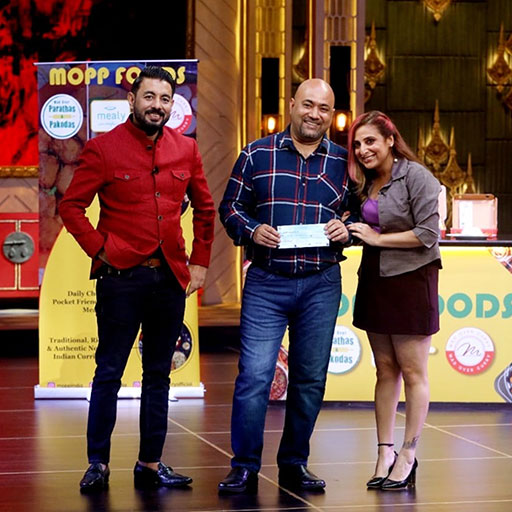

Mopp Foods Shark Tank journey is a compelling story of identifying a gap in India massive food delivery market. When Geetika Anand Gupta and Gaurav Gupta pitched their cloud kitchen brand Mad Over Paratha and Pakoda in Season 2, they highlighted a peculiar problem: while pizzas and burgers had strong delivery brands, Indians favorite comfort foods—parathas and pakodas—lacked a hygienic, mid-segment branded player that could solve the sogginess issue inherent in delivery. Appearing in January 2023, the husband-wife duo asked for ₹75 lakhs for 2.25% equity, valuing their company at ₹33.33 crores. What followed was an intense negotiation focusing on unit economics, brand strategy, and the challenges of aggregator dependence, ultimately leading to a strategic investment from CarDekho founder Amit Jain.
Business Overview
Mopp Foods, an acronym for Made Over Paratha and Pakoda, operates on a cloud kitchen model designed to deliver authentic North Indian cuisine that remains crispy and non-oily even after traveling long distances. The founders identified that while India has numerous brands for pizzas, burgers, and even momos, the paratha and pakoda market—despite being massive—remained largely unorganized. Customers either had to settle for roadside vendors with questionable hygiene or expensive five-star hotels, leaving a significant gap in the mid-premium segment.
The company employs a proprietary magical recipe and specialized batter application that ensures their pakodas and parathas retain their crunch for over an hour, solving the primary pain point of fried foods becoming soggy during delivery. Beyond their flagship brand, Mopp Foods also operates Mealy for daily meals and Mad Over Curry for authentic North Indian curries, all running from a single cloud kitchen infrastructure to maximize operational efficiency.
| Company Attribute | Details |
|---|---|
| Founded | 2019 (Launched May 2019) |
| Founders | Geetika Anand Gupta & Gaurav Gupta |
| Headquarters | Delhi NCR |
| Primary Brand | Mad Over Paratha & Pakoda |
| Business Model | Cloud Kitchen / Multi-brand Operator |
| Key USP | Crispy, non-soggy delivery of fried foods |
About Founder’s
Geetika Anand Gupta and Gaurav Gupta bring a unique blend of culinary passion and operational expertise to Mopp Foods. The couple spent 14 years in Dubai before returning to India in 2019. Geetika, who is the primary visionary behind the food innovation, felt a strong calling to serve authentic desi flavors she missed while abroad. Her husband Gaurav complements her with strong analytical skills and business acumen, handling the financial and operational aspects of the venture. Married for 18 years at the time of the pitch, their strong chemistry and mutual respect were evident to the Sharks, with Geetika humorously noting that while she identifies the opportunities, Gaurav often executes them after initial hesitation.
- Founded by husband-wife duo Geetika and Gaurav Gupta after returning from Dubai
- Geetika drives culinary innovation with 20+ years of cooking experience
- Gaurav manages operations, finance, and investor relations
- Successfully raised multiple funding rounds before Shark Tank appearance
- Built company to ₹60 lakh monthly run rate with just three kitchens
Shark’s and Founder’s QnA
Amit Jain asked how the idea for combining parathas and pakodas came about and why they chose this specific combination.
Geetika explained that after spending 14 years in Dubai, upon returning to India, she wanted to serve authentic desi parathas and pakodas. They noticed that while there were either ₹50 roadside options or expensive five-star hotel offerings, there was no mid-segment hygienic brand available. Gaurav added that they do not enjoy cooking these items at home due to the mess and time involved, yet ordering them from existing options resulted in soggy, oily food, creating the perfect market opportunity.
Anupam Mittal questioned the meaning behind the name Mopp, suggesting it sounds like Jhadu (broom) in Hindi.
Geetika clarified that MOPP stands for Made Over Paratha and Pakoda. She acknowledged the confusion and stated they were flexible about changing the name if needed, as they were already running three brands from one kitchen and planning a fourth, making the current acronym less relevant to their expanding portfolio.
Amit Jain inquired about the funding history and current equity split.
Gaurav detailed their journey: In January 2020, they raised ₹71 lakhs from Rahul Singh (founder of Beer Cafe) at a ₹4 crore pre-money valuation. In November 2021, they raised approximately ₹70 lakhs via India Accelerator at a ₹12 crore valuation. In March 2022, they raised another ₹55-60 lakhs at a ₹12.5 crore valuation. Most recently, they raised ₹55 lakhs at a ₹22 crore valuation through Rebel Foods Launcher program. He revealed that the founders currently hold 61% equity combined, with 20% held by angel investors, 9.3% as ESOP, 6% with advisors, and 3% with India Accelerator.
Anupam Mittal expressed concern about the power of food delivery aggregators like Zomato and Swiggy and how Mopp Foods would maintain margins.
Gaurav acknowledged this is a scale game. He explained that while aggregators take 24-25% commission, their cloud kitchen model keeps store-level EBITDA positive at 12%. Their strategy is to expand rapidly to 100 kitchens, which will average out corporate costs currently at ₹7 lakhs per month, bringing them down to 4-5% of revenue and making the overall business profitable.
Aman Gupta highlighted the difference between brand pull versus dependency on marketplace listings.
He noted that with three brands splitting the ₹60 lakh monthly revenue (averaging ₹20 lakh per brand), they were heavily dependent on aggregator listings rather than strong brand recall. He argued that without brand pull akin to Domino’s, which can operate independently of Zomato, scaling to profitability would remain challenging. Consequently, he decided to go out.
Peyush Bansal stated his decision to go out.
He explained that while the numbers were impressive, his primary issue was the multi-brand approach. He believed that if the founders had focused on building just one strong brand instead of three (and planning a fourth), he would have considered investing, but the divided focus did not align with his investment thesis.
Amit Jain offered ₹50 lakhs for 5% equity plus ₹25 lakhs debt.
He praised the founders for their precise unit economics and financial clarity. He stated that while he had no expertise in the food space, he believed they would become profitable and he could learn from them. His offer valued the company at ₹15 crores.
The founders countered Amit Jain offer.
Gaurav requested ₹75 lakhs for 5% equity, removing the debt component entirely. He explained that they had recently turned corporate-level EBITDA positive (reducing the ₹3 lakh burn), making debt unnecessary. He emphasized the need to remain fair to their initial supporters who invested at lower valuations.
Amit Jain accepted the counter offer of ₹75 lakhs for 5% equity.
He appreciated the founders loyalty to their early investors and agreed to the all-equity deal, finalizing the transaction at a ₹15 crore valuation.
Key Stats & Financials
At the time of their Shark Tank appearance, Mopp Foods demonstrated impressive traction for a cloud kitchen startup. They had achieved a monthly revenue run rate of ₹60 lakhs through just three kitchens, delivering approximately 25,000 orders per month. Their financial discipline was evident in their store-level profitability, with each kitchen operating at a positive EBITDA of 12%. While they were burning roughly ₹3 lakhs per month at the corporate level due to expansion costs, they had recently achieved corporate-level profitability, a rare feat in the cloud kitchen industry.
- Monthly Revenue Run Rate: ₹60 Lakhs (at time of pitch)
- Monthly Orders: 25,000 across 3 operational kitchens
- Store-Level EBITDA: 12% positive
- Corporate Burn: ₹3 Lakhs (recently turned positive)
- Projected Annual Revenue: ₹100 Crores (target for next year)
| Financial Metric | Value |
|---|---|
| Original Ask | ₹75 Lakhs for 2.25% (₹33.33 Cr val) |
| Final Deal | ₹75 Lakhs for 5% (₹15 Cr val) |
| Cost of Goods Sold | 35% (Food + Packaging) |
| Aggregator Commission | 24-25% (Zomato/Swiggy) |
| Gross Margin | 40% |
| Occupancy Cost | 7% (Rent + Maintenance) |
Business Potential and TAM
The Indian cloud kitchen market represents a massive opportunity, projected to become a $4.4 billion market by 2032 according to industry reports. Mopp Foods is strategically positioned to capture a significant share of the North Indian cuisine segment within this growing pie. The founders outlined an aggressive expansion plan to scale from 3 kitchens to 100 kitchens within the next 12 months, targeting ₹100 crores in annual revenue. Each kitchen is projected to contribute ₹2 to 2.5 crores annually at scale, with a clear path to maintaining 20% store-level EBITDA.
Their addressable market includes not just traditional food delivery through Zomato and Swiggy, but also the burgeoning quick commerce sector, where companies like Zepto and Blinkit are promising 10-minute food delivery. By leveraging partnerships with cloud kitchen aggregators like Rebel Foods and Kouzina Food Tech, Mopp Foods can expand nationally without the heavy capital expenditure associated with traditional restaurants.
- Target expansion to 40-50 kitchens to hit ₹100 Cr revenue run rate
- Average kitchen revenue target: ₹2-2.5 Crores per annum
- Store-level EBITDA target: 20% at full scale
- Corporate EBITDA target: ₹10 Crores on ₹100 Crore revenue
- Strategic partnerships with Rebel Foods and Kouzina for pan-India reach
Mopp Foods: Ideal Target Audience & Demographics
| Demographic | Details |
|---|---|
| Age Group | 25-45 years (Working professionals) |
| Location | Metro cities and Tier 1 cities initially |
| Income Level | Middle to upper-middle class |
| Food Preference | North Indian cuisine, comfort food seekers |
| Ordering Behavior | Regular online food delivery users |
| Key Pain Point | Lack of hygienic, crispy homestyle options |
Marketing and Distribution Strategy
Mopp Foods operates on an asset-light cloud kitchen model, eliminating the high real estate costs of dine-in restaurants. Their primary distribution channels are food delivery aggregators Zomato and Swiggy, which currently drive the majority of their orders. However, the long-term strategy focuses on building direct brand pull through consistent quality and unique product offerings like the Butter Chicken Paratha and Butter Chicken Pakoda, which cannot be easily replicated by competitors.
The company utilizes a multi-brand strategy to maximize kitchen utilization throughout the day—Mealy for daily meals, Mad Over Paratha for snacks, and Mad Over Curry for main courses. Future roadmap includes expanding into quick commerce channels and potentially launching physical QSR (Quick Service Restaurant) outlets through strategic partnerships, as evidenced by their post-Shark Tank collaboration with Kouzina Food Tech to leverage existing infrastructure across South India.
- Heavy reliance on Zomato and Swiggy for customer acquisition
- Multi-brand strategy to optimize kitchen capacity and daypart utilization
- Focus on unique product innovation (Italian Twist Paratha, Butter Chicken Pakoda)
- Partnership with Rebel Foods Launcher program for technology and expansion support
- Post-show integration with Kouzina Food Tech for South India penetration
Mopp Foods Deal Outcome
After intense scrutiny regarding their multi-brand approach and dependence on aggregators, Mopp Foods secured a deal with Amit Jain, the co-founder of CarDekho. While four Sharks declined due to concerns about brand scalability and personal expertise gaps, Amit recognized the financial discipline and operational efficiency demonstrated by the founders. The final agreement was reached after the founders successfully negotiated to remove the debt component from the initial offer, ensuring a cleaner cap table aligned with their recent achievement of corporate-level profitability.
| Deal Terms | Details |
|---|---|
| Investing Shark | Amit Jain |
| Investment Amount | ₹75 Lakhs (All Equity) |
| Equity Acquired | 5% |
| Company Valuation | ₹15 Crores |
| Original Ask | ₹75 Lakhs for 2.25% |
| Counter Offer | ₹75 Lakhs for 5% (No Debt) |
Mopp Foods Post-Show Update
Following their successful Shark Tank appearance, Mopp Foods witnessed significant growth and strategic developments. In early 2025, Bengaluru-based Kouzina Food Tech announced a strategic investment in Mopp Foods, acquiring majority representation on the board though the financial details were not disclosed. This partnership enables Mopp Foods to expand aggressively to 200 cloud kitchens by leveraging Kouzina existing network across 90 cities, particularly strengthening their presence in South India.
The collaboration allows both companies to cross-utilize infrastructure and technology, with Mopp focusing on authentic North Indian flavors while Kouzina manages operational scale. This deal positions Mopp Foods as a serious competitor to established players like Curefoods and Rebel Foods in the growing cloud kitchen ecosystem, validating Amit Jain early bet on the team’s execution capabilities.
Business Analysis & Lessons
The Mopp Foods pitch offers several valuable lessons for aspiring entrepreneurs in the food tech space. First, unit economics clarity is crucial; Gaurav detailed knowledge of per-kitchen costs, direct expenses, and EBITDA margins immediately established credibility with the Sharks. Second, the importance of founder-market fit was evident—Geetika authentic passion for North Indian cuisine combined with Gaurav operational excellence created a balanced leadership team.
However, the pitch also highlighted the risks of aggregator dependence in the food delivery business. The Sharks concerns about Zomato and Swiggy commission structures underscore the need for brands to build direct customer relationships. Additionally, the debate around single versus multi-brand strategy suggests that while operational efficiency favors multiple brands per kitchen, investor confidence often favors focused brand building. The founders ability to secure a deal despite these concerns demonstrates that transparent communication and proven profitability can overcome strategic hesitations.
- Master your unit economics before seeking investment
- Maintain fair treatment of early investors during negotiation
- Balance operational efficiency (multi-brand) with brand building (single focus)
- Asset-light models (cloud kitchens) attract investors despite thin margins
- Turning profitable before fundraising significantly strengthens negotiating position
Pitch Conclusion
Mopp Foods Shark Tank appearance serves as a masterclass in financial transparency and strategic negotiation for cloud kitchen entrepreneurs. By securing a deal with Amit Jain at favorable terms despite investor skepticism about their multi-brand approach, Geetika and Gaurav Gupta proved that solid unit economics and operational discipline can overcome market doubts. Their subsequent partnership with Kouzina Food Tech positions them for exponential growth, potentially making Made Over Paratha and Pakoda a household name across India 200 cities. For foodpreneurs watching at home, the key takeaway is clear: know your numbers, respect your early backers, and ensure your product solves a real delivery pain point.