



Pitch Introduction
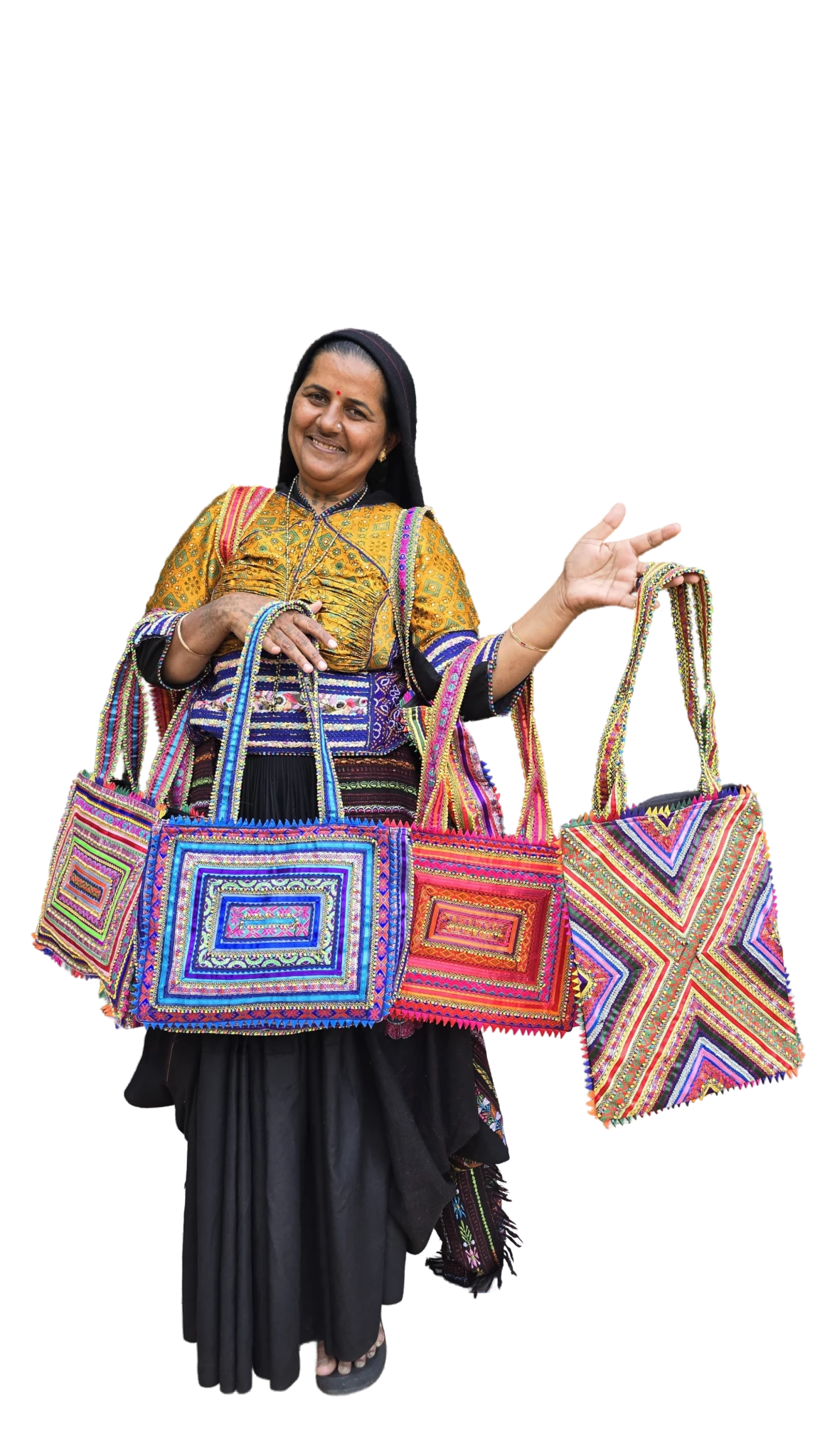
The Pabiben Shark Tank India pitch brought the rich heritage of Gujarat directly to the national stage. Presenting their unique business model, founders Pabiben Rabari and Nilesh Priyadarshi appeared in Season 2, Episode 32 to showcase their handcrafted bag and accessory brand. The founders sought an investment of ₹50 Lakhs in exchange for 5% equity, valuing their company at ₹10 Crores.
This pitch stood out on Shark Tank India because it combined commercial viability with deep social impact. By the end of their presentation, the founders managed to secure a combined equity and debt deal with Namita Thapar. The business operates in the growing eCommerce sector, aiming to give rural artisans the recognition they deserve.
Business Overview
Pabiben.com is an online platform that brings the intricate art of Rabari embroidery directly to consumers. The brand solves a historical problem in the handicraft sector where big designers buy artisan work for very little money and sell it at high markups. By operating their own direct-to-consumer platform, the company ensures that the women who create these products receive fair compensation and proper recognition.
The product catalog features around 500 SKUs, including bags, accessories, and gift boxes. Their signature product is the Pabi Bag, which has gained significant popularity. A fully hand-embroidered bag from their collection sells for ₹6,900. Unlike generic marketplace sellers, the company is building a distinct brand identity to ensure long-term sustainability for their artisan network.
| Company Detail | Information |
|---|---|
| Company Name | Pabiben |
| Industry | eCommerce |
| Founded | Not explicitly stated |
| Headquarters | Ahmedabad, Gujarat |
| Founders | Pabiben Rabari, Nilesh Priyadarshi, Nupur Kumari |
| Website | https://www.pabiben.com/ |
About the Founders
The company is driven by three equal partners under their parent entity, Eye Catching Young Entrepreneurs. Pabiben Rabari hails from a small village called Bhadra in Kutch. She faced significant personal challenges early in life, losing her father when she was just five years old. Growing up in a community that often undervalued daughters, she developed a strong determination to erase that stigma and build something meaningful through her embroidery skills.
Nilesh Priyadarshi spent 10 years working in Kutch, focusing specifically on handicrafts and understanding the marketing challenges faced by rural artisans. Nupur Kumari completes the trio by managing the design aspects of the business. Together, they have built a system that not only sells products but also provides business health checkups and brand development for other artisans through their Karigar Clinic initiative.
- Pabiben lost her father in a well accident at age five.
- She was motivated to prove the value of daughters in her community.
- Nilesh has a decade of experience in rural handicraft marketing.
- The founders run three distinct initiatives to support the artisan ecosystem.
Sharks and Founders QnA
What is your role?
We run Eye Catching Young Entrepreneurs, a company in which I, Nupur Kumari and Pabi Ban are all equal partners. We do three different types of work in it. We sell all the Rabari embroidery items through Pabi.com.
Whether you will take money in Eye Catching Company or Pabi Bun will take money in Eye Catching?
Everything will happen together, meaning whatever happens will be under it. First of all we thought of creating a model and the first model we created was Pabi Bun Co and this is how our journey started.
What will be the price of this bag?
90. This is not hand embroidered, right, it is not in pieces, so what will be its price, the one with hand embroidery, 6900 sales.
Tell me SKU, we have around 500 SK uses or is this just Pabi Ban?
Including all the current Pabi Ban and some of the things we make from waste plastic, all together we have 500 SK uses and till now we have done sales of Rs 2 crore.
Tell me a little about sales.
We have done sales in the last five years and last year our sales were Rs 36 lakh, before that our sales were Rs 28 lakh and in the year before that our sales were Rs 33 lakh.
We are making profit now?
Yes our margin is Rs 50 and profit net profit is Rs 35.
Don’t you think that it will reach more homes, if we go and sell on some platform?
If we go and sell on some platform then the majority of the profit will be from that platform, if you see this pouch of theirs lying at someone’s house then they don’t even know whose pouch it is.
I am offering you a hearty deal, you can go out and talk to us, give me some time, come to me quickly.
Namita ji, I liked your offer very much, we have a counter offer, being a Gujarati, I did not negotiate, so what did I do, our offer is that we will give you Rs. 5 You give me the equity, you give me 10 lakhs and give me an interest loan of 40 lakhs.
Key Stats and Financials
The company showcased strong unit economics during their pitch. With a gross margin of 50% and a high net margin of 35%, the business is operating highly efficiently. They reported lifetime sales of ₹2 Crores over five years. Their revenue trajectory showed slight fluctuations, reporting ₹33 Lakhs two years ago, dipping to ₹28 Lakhs, and recovering to ₹36 Lakhs in the year prior to filming.
The founders initially asked for ₹50 Lakhs for 5% equity, which implied a valuation of ₹10 Crores. Ultimately, they structured a deal that minimized equity dilution while securing the necessary capital through a 0% interest loan. This combination of debt and equity allowed them to maintain a ₹2 Crores valuation for the equity portion.
- Ask: ₹50 Lakhs for 5% equity
- Valuation: ₹10 Crores
- Yearly Revenue: ₹36 Lakhs (most recent year)
- Gross Margin: 50%
- Net Margin: 35%
| Financial Metric | Amount |
|---|---|
| Original Ask | ₹50 Lakhs for 5% |
| Valuation Requested | ₹10 Crores |
| Final Deal Amount | ₹10 Lakhs |
| Final Deal Equity | 5% |
| Deal Valuation | ₹2 Crores |
| Debt Component | ₹40 Lakhs at 0% interest |
Business Potential and Market Size
The market for authentic, artisan-made ethnic goods is expanding rapidly in India. Consumers are increasingly drawn to sustainable, culturally rich products that tell a story. The business operates within a premium niche of the accessories market, catering to buyers who appreciate handmade craftsmanship over mass-produced alternatives.
By empowering women artisans directly, the company taps into the powerful narrative of social entrepreneurship. This approach not only secures a loyal customer base but also opens doors for corporate gifting and international exports. The founders aim to replicate this model across different villages, turning local artisans into micro-entrepreneurs.
- Growing consumer preference for ethical and sustainable fashion.
- High profit margins allow for steady organic growth.
- Significant potential in the international export market.
- The social impact story builds strong brand loyalty.
Ideal Target Audience for Pabiben
| Demographic | Details |
|---|---|
| Primary Audience | Conscious consumers and fashion enthusiasts |
| Age Range | 25 to 55 years |
| Geography | Pan India Tier 1 cities and international markets |
| Income Segment | Mid to Premium income groups |
| Buying Trigger | Appreciation for authentic artisan craft and heritage |
| Channels They Use | Direct website and boutique offline stores |
Marketing and Distribution Strategy
The company strictly controls its distribution to protect its brand identity. During the pitch, Nilesh explained that selling through large online marketplaces often diminishes brand recall, as customers remember the platform rather than the creator. Therefore, they focus heavily on their own direct-to-consumer website to maintain a direct relationship with buyers.
Looking ahead, they plan to launch Karigar Ki Dukaan, a dedicated platform to serve as a permanent marketplace for artisan entrepreneurs. This strategy allows them to control their pricing, maintain high margins, and ensure the artisan’s name remains front and center in every transaction.
- Direct sales through the proprietary company website.
- Avoidance of generic marketplaces to build distinct brand recall.
- Future expansion plans include creating individual digital shops for different arts.
- Story-driven marketing highlighting the women behind the craft.
Pabiben Deal Outcome
The negotiation phase highlighted the tension between pure business metrics and social impact. Peyush Bansal opted out, noting that the business was already profitable and taking on equity investment might create unnecessary pressure for rapid growth. Vineeta Singh felt the current scale was too small for her to invest, while Anupam Mittal stepped back, advising them to focus heavily on public relations and storytelling before raising capital. Aman Gupta praised their mission but chose not to invest.
Namita Thapar, moved by the founder’s story and the impact on rural artisans, offered a supportive structure. She proposed ₹5 Lakhs for 2% equity alongside a ₹45 Lakhs interest-free debt facility. Showing sharp negotiation skills, Nilesh countered with ₹10 Lakhs for 5% equity and ₹40 Lakhs in debt. Namita happily accepted the counter-offer, sealing the deal.
| Deal Component | Details |
|---|---|
| Sharks Present | Namita Thapar, Vineeta Singh, Anupam Mittal, Aman Gupta, Peyush Bansal |
| Offers Received | Yes, from Namita Thapar |
| Final Deal Amount | ₹10 Lakhs + ₹40 Lakhs Debt |
| Final Equity | 5% |
| Investing Shark(s) | Namita Thapar |
| Royalty Terms | None |
Pabiben Post-Show Update
Following their appearance on national television, the brand experienced remarkable success. According to updates shared on their official social media, the business achieved a massive 3x growth in revenue. The exposure allowed them to double their weaver community, directly impacting more rural households.
Their momentum continued as they were named finalists for the National Startup Awards. Beyond domestic success, the brand achieved global recognition. The founder was invited to host a talk at the Nobel Peace Center and successfully showcased the artisan products in the USA, proving that traditional Indian crafts have a strong international market.
Business Lessons from This Pitch
This pitch offers a masterclass in balancing profitability with purpose. The founders proved that social entrepreneurship does not require sacrificing margins. By maintaining a 35% net profit, they demonstrated that paying artisans fairly and running a lucrative business can happen simultaneously.
Another major takeaway is the strategic use of debt. Instead of giving up a large chunk of their company for the full ₹50 Lakhs ask, the founders secured 80% of their required capital as a zero-interest loan. This preserved their equity while giving them the cash flow needed to scale operations.
- Protect your brand identity by carefully selecting your sales channels.
- Interest-free debt is an excellent way to fund inventory without losing ownership.
- A strong social mission can serve as a powerful differentiator in a crowded market.
- Do not be afraid to counter-offer, even when speaking to prominent investors.
Pitch Conclusion
The Pabiben pitch remains one of the most heartwarming yet commercially sound presentations in the show’s history. By securing the capital they needed while keeping their mission intact, the founders are well-positioned to turn local artisan crafts into a globally recognized brand.
What do you think of their decision to avoid major online marketplaces to protect their brand identity? Share your thoughts below. If you enjoy seeing strong traditional brands secure funding, be sure to read our breakdown of Zoff Foods, another company bringing Indian culture to the modern market.