


Pitch Introduction
The Tileskraft Shark Tank India pitch brought a refreshing perspective to the Indian construction material sector. Founder Bindiya Mehta, a third-generation entrepreneur from Morbi, Gujarat, stepped onto the stage to digitize a legacy industry worth ₹75,000 Crores. Seeking ₹60 Lakhs for 12% equity, she aimed to bridge the gap between global manufacturing hubs and individual homeowners through an innovative sampling model. While her presence as a rare female leader in the ceramic industry impressed the panel, the viability of her specific business model sparked intense debate among the Sharks.
Business Overview
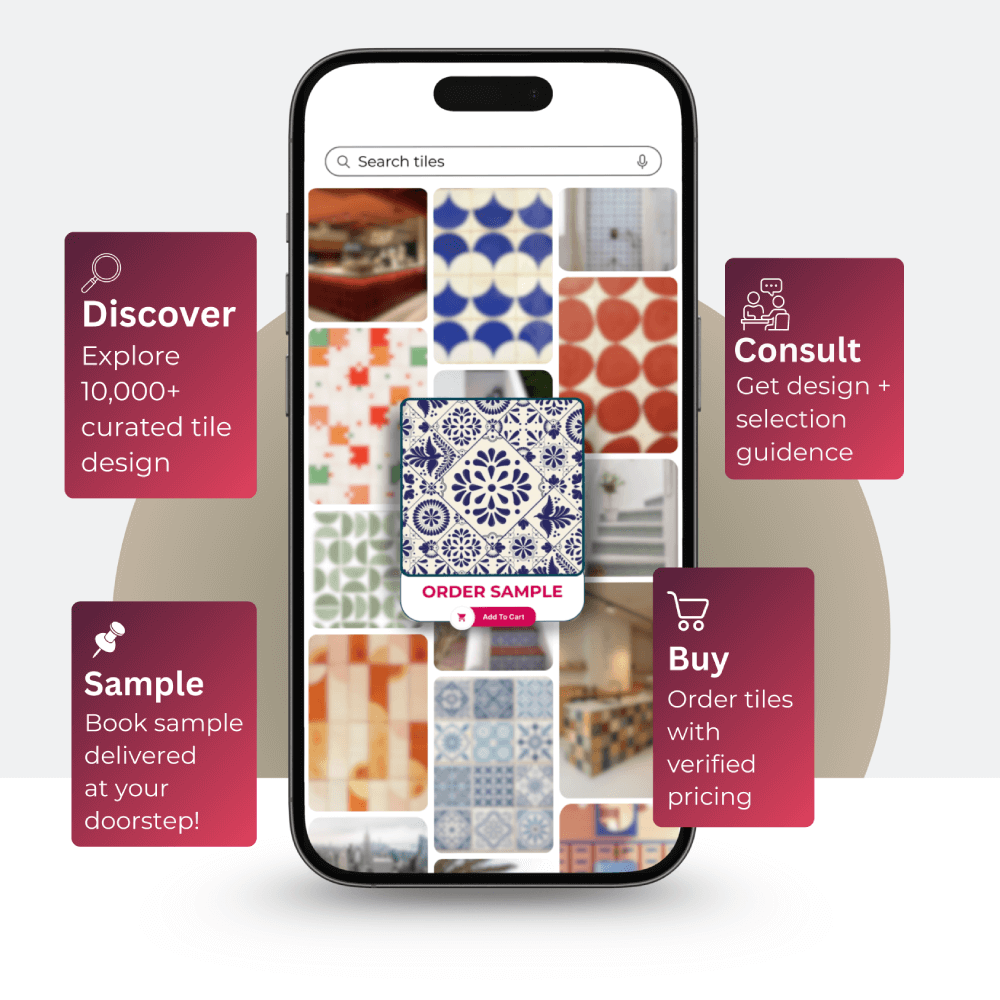
Tileskraft operates as an online tile sampling and sourcing platform. Traditionally, buying tiles requires physical visits to local showrooms with limited inventory or a journey to Morbi, the world’s second-largest ceramic cluster. Bindiya Mehta identified that while manufacturing in India has reached world-class standards, distribution remains archaic and fragmented. Tileskraft solves this by bringing the vast variety of Morbi‘s 800+ factories to the consumer’s doorstep via a digital catalog and physical sampling service.
The company employs an asset-light model, partnering with over 65 suppliers to offer thousands of SKUs. By cutting out multiple layers of middlemen, Tileskraft claims to offer price advantages of 20-30% to the end consumer. The business focuses on high-touch customer service, guiding first-time home builders through the technical complexities of tile selection, from material composition to installation requirements.
Product Details
The core product is a logistics and technology layer for the ceramic industry. Tileskraft provides high-quality physical samples of floor and wall tiles, which are traditionally difficult to ship due to their weight and fragility. The platform features a curated digital catalog where users can filter tiles by size, finish (glossy, matt, satin), and application area. The startup handles the precision cutting of samples, branding, and efficient packaging to ensure zero breakage during transit, providing a “touch and feel” experience before a bulk order is placed.
Market Position
Tileskraft positions itself as a value-added aggregator. Unlike local retailers who stock only fast-moving items, Tileskraft offers specialized, designer, and large-format tiles that are usually reserved for high-end projects. Their USP lies in their proximity to the source (Morbi) and their ability to provide transparency in pricing. While competitors like Homestrap focus on home organization, Tileskraft targets the fundamental building block of interior design, competing indirectly with legacy showrooms and emerging D2C material platforms.
| Business Detail | Information |
|---|---|
| Company Name | Tileskraft |
| Founder | Bindiya Mehta |
| Product Type | Online Tile Marketplace & Sampling |
| Price Range | Designer Tiles (Wholesale Rates) |
| Primary Channel | Direct-to-Consumer Website |
| Headquarters | Morbi, Gujarat |
About Founder’s
Bindiya Mehta is a third-generation entrepreneur who practically grew up amidst the kilns of Morbi. Her grandfather manufactured cement tiles, and her father runs a wholesale business for tuff tiles. Holding an MBA in Marketing from Ahmedabad University, Bindiya previously worked as an Accounts Officer at Nestle India, managing modern trade for the South Gujarat belt. Her transition back to her hometown during the pandemic led her to recognize the lack of digital adoption in her family’s trade. According to The Indian Express, Shark Anupam Mittal lauded her as an “anomaly” for being a woman leader in a male-dominated industrial town.
- MBA Graduate from Ahmedabad University with a background in FMCG sales.
- Third-generation ceramic business legacy holder.
- Started Tileskraft in 2022 as a proof-of-concept website.
- Single-handedly manages operations in the industrial hub of Morbi.
Shark’s and Founder’s QnA
What is the scale of the Morbi tile industry?
The tile industry in my town is worth ₹75,000 Crores. There are approximately 800 factories, and we export about ₹22,000 Crores worth of tiles globally. It is the ceramic capital of India.
How is your business different from your father’s legacy business?
My father handles wholesale for builders and deals in mass quantities. He doesn’t have the bandwidth for small, customized orders or designer selections for individual homes. I focus on the end-user, providing N-to-N service and specific variety that wholesale models ignore.
What is the benefit for a consumer to buy through Tileskraft?
Consumers get a selection that is 10x wider than a local showroom and a price benefit of 20% to 30%. We also provide expert guidance, as most first-time buyers have no knowledge about tile technicalities.
Are there no other companies doing tile sampling online in India?
While there are companies like Material Depot, their sampling models are often integrated with physical presence. My model is more focused on direct sourcing from the manufacturer and delivering that variety efficiently through a digital-first approach.
What are your current financial numbers?
Last year, we did ₹58 Lakhs in revenue with a net profit of ₹9.95 Lakhs. This year, we have already done ₹31.66 Lakhs and have ₹33 Lakhs worth of purchase orders in hand. We expect to close the year at ₹1.2 Crores with ₹20 Lakhs in profit.
Why do you need the Sharks if you are already profitable?
Currently, the business is a digital catalog. I want to build a full-scale platform with automated lead generation for manufacturers and a standardized sampling facility. I need expertise to scale this beyond my current manual operations.
Key Stats & Financials
Tileskraft showcased a lean, profitable growth trajectory. Starting with just ₹35.5 Lakhs in revenue in FY 2022-23, the founder managed to scale to ₹58 Lakhs the following year while maintaining double-digit net margins. This is particularly impressive for a startup in the construction tech space, which often requires heavy capital for inventory. By remaining asset-light and focusing on high-margin designer tiles, Bindiya Mehta has built a sustainable, albeit small, business engine.
Revenue and Profitability
- Lifetime Sales: Approximately ₹1.25 Crores since inception.
- Profit Margins: Net profit of 17% (₹9.95 Lakhs on ₹58 Lakhs revenue).
- Valuation: Requested ₹5 Crores (₹60 Lakhs for 12%).
- Investment Request: ₹60 Lakhs for growth and tech development.
- Projected Revenue: Targeting ₹1.2 Crores for the current fiscal year.
Financial Breakdown
| Metric | Amount / Value |
|---|---|
| FY 2022-23 Sales | ₹35.5 Lakhs |
| FY 2023-24 Sales | ₹58 Lakhs |
| Target FY 2024-25 | ₹1.2 Crores |
| Current Net Profit | ₹9.95 Lakhs |
| Projected Profit | ₹20 Lakhs |
| Marketing Spend | Low (Organic/Referral) |
Business Potential and TAM
The business potential for Tileskraft is anchored in the massive Indian Ceramic Market. India is currently the second-largest manufacturer and consumer of ceramic tiles in the world. The domestic market is projected to grow at a CAGR of 8-10% over the next decade, fueled by the government’s push for affordable housing and urban infrastructure development. Morbi alone contributes nearly 90% of India’s tile production. By digitizing the discovery process, Tileskraft is tapping into a multi-billion dollar opportunity where 80% of the market is still unorganized or dependent on offline showrooms.
Market Size Analysis
The total addressable market (TAM) for tiles in India is estimated at over ₹75,000 Crores. Out of this, the retail segment (individual home builders) makes up a significant portion. As digital penetration increases in Tier 2 and Tier 3 cities, the Serviceable Obtainable Market (SOM) for platforms like Tileskraft could easily exceed ₹1,000 Crores within the next five years. The rise of “Prop-tech” and the increasing influence of interior designers on purchase decisions further expand the reach of sampling-based models.
Growth Opportunities
- Architect & Designer Portal: Creating a dedicated login for professionals to earn commissions and track samples.
- Private Labeling: Launching a ‘Tileskraft’ curated collection by partnering with high-end manufacturers for exclusive designs.
- Pan-India Logistics Hubs: Setting up micro-warehouses in major metros to reduce sample delivery time from 5 days to 24 hours.
- International Exports: Using the ₹22,000 Crore export market to provide sampling services for international B2B buyers.
Tileskraft: Ideal Target Audience & Demographics
| Demographic | Details |
|---|---|
| Primary Age Group | 28 – 55 Years |
| Secondary Age Group | Architects (25 – 45 Years) |
| Interests | Home Decor, Interior Design, Real Estate |
| Platform Preference | Instagram, Pinterest, Google Search |
| Geography | Tier 1 and Tier 2 Cities in India |
| Buying Behavior | First-time homeowners building luxury or semi-luxury homes |
Marketing and Distribution Strategy
Currently, Tileskraft relies heavily on organic search and word-of-mouth within the Morbi network. The founder manages inquiries personally, converting digital interest into sales through WhatsApp and phone consultations. This high-touch model ensures trust, which is crucial in a high-ticket industry where customers are wary of online scams and material quality. The distribution is managed through third-party logistics providers specialized in handling fragile ceramic goods.
Customer Acquisition
Customer acquisition is primarily driven by SEO-focused content regarding tile designs and Morbi factory price advantages. The founder mentioned that customers find them online, check the digital catalog, and then request physical samples. The current CAC is extremely low due to the organic nature of the platform, but scaling will require targeted performance marketing on Meta and Google Ads, specifically bidding on keywords related to home renovation and specific tile brands.
Distribution Channels
- D2C Website: The primary interface for product discovery and sample ordering.
- WhatsApp Business: Used for 90% of final closures and technical guidance.
- Manufacturer Direct: Dropshipping model where orders are shipped from the factory directly to the end-user.
- Offline Retailer Tie-ups: Future plan to use retailers as fulfillment centers for samples.
Social Media and Content Strategy
The company focuses on visual platforms like Instagram to showcase real-life site photos of installed tiles. By providing “actual photos” rather than just rendered images, Tileskraft builds authenticity. Their content strategy involves educating users on tile sizes (e.g., 600x1200mm vs 800x1600mm) and helping them understand which finish is best for bathrooms versus living rooms.
Tileskraft Shark Tank Deal Outcome
Despite Bindiya Mehta’s stellar background and the profitability of her business, Tileskraft failed to secure a deal on Shark Tank India. The Sharks were divided on the business model. Peyush Bansal argued that for the business to be truly disruptive, it must go 100% Direct-to-Consumer (D2C) and own the supply chain. Aman Gupta and Amit Jain felt the “D2R” (Direct to Retailer) sample model was too complex and easily bypassable by manufacturers.
| Shark | Offer Detail |
|---|---|
| Peyush Bansal | Out – Felt the model was three steps away from fundraising. | Out – Advised the founder to learn and earn without investors. | Out – Believed the model was too complex for D2C scaling. | Out – Saw the sampling proposition as too thin. |
| Final Decision | No Deal |
Tileskraft Post-Show Update
Post-pitch, Tileskraft has continued to operate as a profitable, independent entity. According to The Times of India, Anupam Mittal’s concluding advice resonated with many: “Sometimes it is better if what you want doesn’t happen.” Bindiya Mehta expressed that the exposure has significantly increased website traffic and interest from manufacturers looking to digitize. Verified post-show revenue figures for Tileskraft are not yet available beyond the projections shared during the episode. We will update this section as reliable information is published.
Business Analysis & Lessons
The strategic analysis of Tileskraft reveals a classic “early-stage dilemma.” The founder identified a real pain point—the difficulty of sourcing variety from Morbi—but the solution presented (a hybrid B2B/B2C sampling app) felt theoretical to the Sharks. The core issue was disintermediation risk: if a consumer finds a tile via a sample, what stops them from going directly to a local dealer or the manufacturer to buy in bulk? To solve this, Tileskraft needs to create a proprietary value layer, such as an installation warranty or exclusive private-label designs.
For entrepreneurs, the Tileskraft pitch serves as a lesson in model clarity. Bindiya attempted to pitch a solution for dealers, manufacturers, and end-users simultaneously. In the early stages, trying to solve for everyone often results in solving for no one. However, her ability to build a profitable ₹58 Lakh business with zero external funding and a lean team is a testament to the power of domain expertise and proximity to the manufacturing source.
Key Takeaways
- Niche Dominance: Being the only woman leader in a specialized industrial hub provides a unique competitive advantage and PR hook.
- Asset-Light Sustainability: Building a profitable business by aggregating existing manufacturers instead of setting up a factory reduces financial risk.
- The Disintermediation Trap: Platforms that provide discovery must ensure they control the transaction or provide post-discovery value to prevent being cut out.
- Customer Education as Sales: In technical industries like construction, the one who educates the customer (on sizes, materials, etc.) usually wins the sale.
Pitch Conclusion
The Tileskraft Shark Tank India journey highlights the immense potential of digitizing India’s traditional manufacturing clusters. While Bindiya Mehta did not walk away with a cheque, her story has inspired many in the Morbi ecosystem. Her profitable model and 3rd generation grit prove that there is massive room for innovation in the home-building sector. If you enjoyed this breakdown, check out Homestrap, Zerodor, and Cellbell.
[faq_accordian]