


Pitch Introduction
The upliance.ai Shark Tank India pitch brought a futuristic vision of the Indian kitchen to the national stage. Founders Mahek Mody and Mohit Sharma, both IIT Bombay graduates, entered Season 3 seeking ₹1 Crore for 1% equity, valuing their startup at a staggering ₹100 Crores. Their product, a smart ‘up-liance,’ aims to bridge the gap for young urban Indians who find home cooking tedious or difficult. By integrating high-tech sensors with a vast database of recipes, they promised to make gourmet cooking as easy as pressing a button.
Business Overview
Founded in 2021 and based in Bangalore, Karnataka, upliance.ai is a lifestyle and home technology company. The core problem they address is the lack of cooking skills and time among modern professionals. According to their pitch, 83% of people find home food boring but lack the expertise to cook complex dishes like pasta, Chinese, or traditional Indian gravies beyond basic Maggi. Their solution is an all-in-one smart jar that handles everything from chopping and stirring to heating and simmering.
The company positions itself at the intersection of hardware and artificial intelligence. Unlike traditional multi-cookers, the ‘upliance’ uses AI to monitor cooking parameters in real-time. It features a built-in screen that guides users through every step, ensuring that even a novice can produce restaurant-quality meals. The device is designed and manufactured in India, specifically tailored for Indian cuisines and cooking styles which often require precise tempering (tadka) and varying heat levels.
Product Details
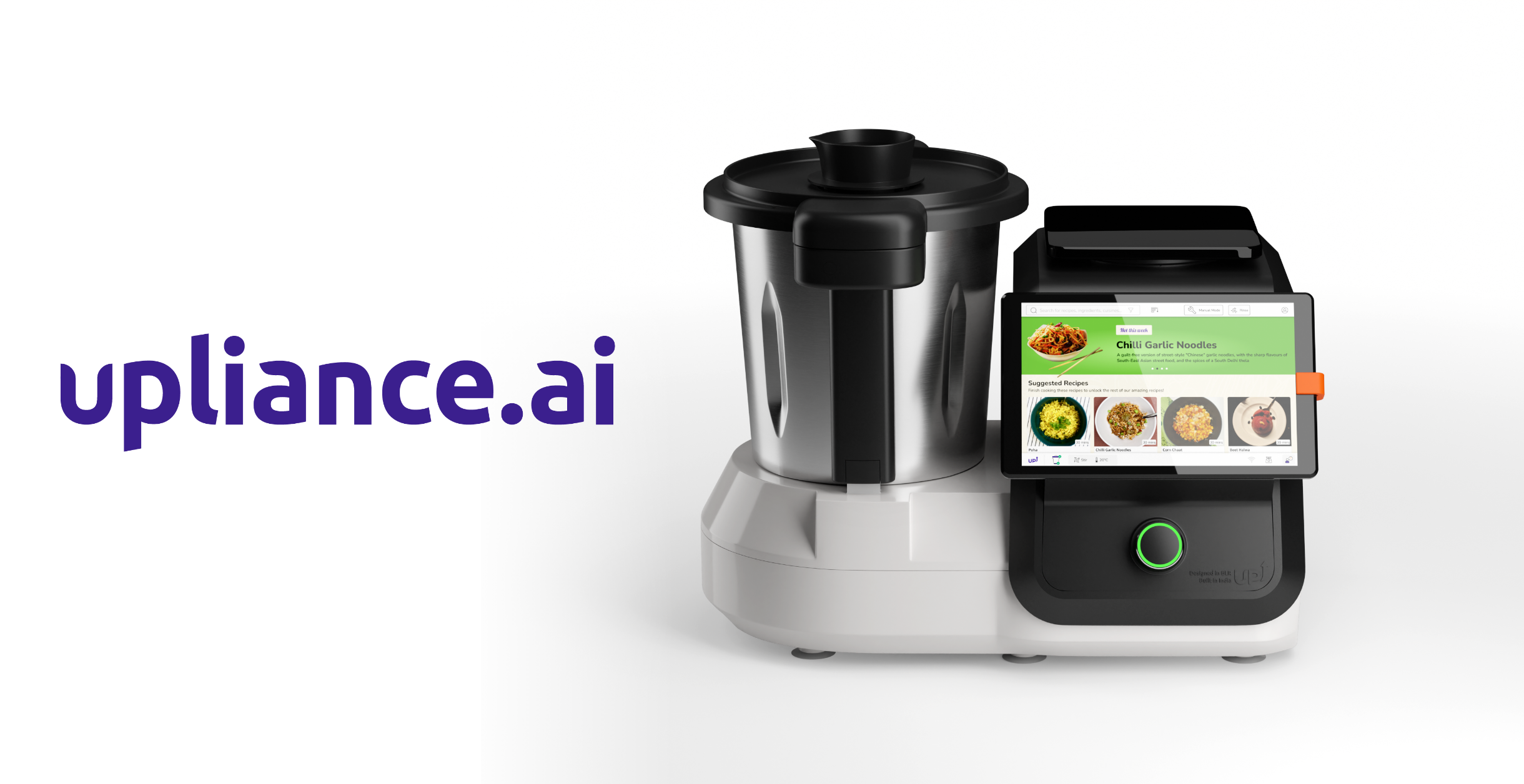
The flagship product is a smart jar equipped with patented technology involving heating elements and thermal sensors. It features omni-blades that can chop, stir, and blend. A unique integrated weighing scale with a magnetic plate allows users to measure ingredients directly into the jar. The device supports over 500 recipes, ranging from Kadai Paneer to Italian pasta and shakes. A standout feature is the AI chatbot that answers cooking queries in multiple Indian languages, providing a truly interactive experience.
Market Position
upliance.ai occupies a premium niche in the Indian kitchen appliance market. While competitors like Wonderchef’s Nutri Pot offer automation, upliance.ai focuses on software-led intelligence and real-time feedback. Their USP is the ability of the machine to ‘understand’ the ingredients through vibration and temperature feedback, theoretically improving with every meal cooked. They target high-income urban households where convenience is prioritized over the cost of the appliance.
| Business Detail | Information |
|---|---|
| Company Name | upliance.ai |
| Founders | Mahek Mody and Mohit Sharma |
| Product Type | Smart Kitchen Appliance |
| Price Range | ₹20,000 to ₹39,999 |
| Primary Channel | D2C (Direct-to-Consumer) |
| Headquarters | Bangalore, Karnataka |
About Founder’s
The founders, Mahek Mody and Mohit Sharma, share a deep technical background. Both are alumni of IIT Bombay (Batch of 2011). Mahek Mody previously worked with Chaayos, where he was instrumental in developing their automated tea-making machines. This experience gave him the foundation to tackle the complexities of automated food preparation. Mahek Mody’s LinkedIn highlights his journey from hardware engineering to consumer tech entrepreneurship.
- Mahek Mody: Graduate of IIT Bombay, former product lead at Chaayos.
- Mohit Sharma: Technical co-founder with a focus on hardware-software integration.
- Started in 2021 with a vision to automate the Indian kitchen.
- Developed 700 units for a pre-production testing batch before the Shark Tank appearance.
Shark’s and Founder’s QnA
What is the actual role of AI in this device?
Actually, there is a glimmer of AI. We have done things like shell onion, which is hard to do in a mixer. The machine takes feedback from vibrations and the speed of the blade. When you add a tadka, we know what type of tadka it is. We stream this data from 700 users to understand the science of a great tadka, moving from high flame to low flame automatically.
Can the output be customized according to different tastes?
Right now, if you are making Kadai Paneer, the output will be the same for everyone based on the recipe. However, we have a feedback system. If owners don’t like something, they tell us through the community, and we use that data to improve the recipes and software parameters for future updates.
What is the background of the founders?
I am a graduate of IIT Bombay from the 2011 batch. Mohit and I are from the same batch. I was previously hired by Chaayos to build a cooking machine that could make tea. We have been working on this specific appliance for about one and a half years now.
What is the selling price and the cost of making?
We sell these machines for ₹20,000. Today, our making cost for this pre-production batch is ₹9,000. However, including all overheads and R&D for this early stage, we are currently seeing a significant loss per unit as we scale up.
What is the global market for such products?
The biggest player is Thermomix, which sells a product for equivalent to ₹1.3 Lakhs and generates revenue of 3 Billion Euros every year. The global market for automatic cooking devices is roughly $2.5 Billion to $3 Billion.
How much funding have you raised and what is your burn?
We raised ₹12 Crores previously. The majority was raised at a ₹49 Crore valuation, and some at ₹78 Crores. We have about ₹5 Crores in the bank right now, and our monthly burn is approximately ₹30 Lakhs.
Key Stats & Financials
At the time of the upliance.ai Shark Tank India pitch, the company was in a critical pre-production and testing phase. They had successfully placed 700 units in the hands of paying customers to gather data and refine the AI algorithms. The business model relies on high-margin hardware sales coupled with a software ecosystem that keeps users engaged with new recipes and community features.
Revenue and Profitability
- Pre-production Sales: 700 units
- Selling Price: ₹20,000 per unit
- Making Cost: ₹9,000 (BOM)
- Monthly Cash Burn: ₹30 Lakhs
- Valuation Asked: ₹100 Crores
- Previous Funding: ₹12 Crores
Financial Breakdown
| Metric | Amount / Value |
|---|---|
| Pre-show Funding | ₹12 Crores |
| Monthly Sales Growth | 10% |
| Customer Base | 700+ Households | ₹12,000 to ₹15,000 |
| Bank Balance (at pitch) | ₹5 Crores |
| Current Valuation | ₹100 Crores (Ask) |
Business Potential and TAM
The potential for upliance.ai lies in the massive shift toward smart home technology in India. As urban sprawl continues and dual-income households become the norm, the demand for time-saving kitchen automation is skyrocketing. The global market for automatic cooking devices is estimated between $2.5 Billion and $3 Billion. In India, while the market is still nascent, it is expected to grow as consumer electronics become more integrated with AI and IoT (Internet of Things).
Market Size Analysis
The Total Addressable Market (TAM) for premium kitchen appliances in India includes approximately 30-40 million urban households. If upliance.ai captures even 1% of this market, they would have 400,000 users. At a price point of ₹20,000, this represents a ₹800 Crore revenue opportunity. The broader smart home market in India is projected to reach several billion dollars by 2030, driven by rising disposable incomes and a preference for tech-enabled living.
Growth Opportunities
- Subscription Model: Offering premium recipe packs or specialized diet plans via AI.
- International Expansion: Targeting the Indian diaspora in the US, UK, and UAE who miss authentic home-cooked food.
- B2B Partnerships: Collaborating with real estate developers to include ‘smart kitchens’ as a standard feature in new apartments.
- Product Diversification: Launching smaller, more affordable versions for bachelors or students.
upliance.ai: Ideal Target Audience & Demographics
| Demographic | Details |
|---|---|
| Primary Age Group | 25-45 Years |
| Secondary Age Group | 45-60 Years (Empty Nesters) |
| Interests | Smart Homes, Healthy Eating, Tech Gadgets |
| Platform Preference | Instagram, YouTube, Tech Blogs |
| Geography | Tier 1 Cities (Bangalore, Mumbai, Delhi, Hyderabad) |
| Buying Behavior | Early Adopters, High Disposable Income |
Marketing and Distribution Strategy
The company employs a modern D2C marketing strategy that focuses on community building and organic growth. During the pitch, the founders mentioned that they had cut marketing costs to zero to focus on organic growth through their existing user base. This ‘community-first’ approach allows them to refine the product based on real-world usage before launching heavy advertising campaigns.
Customer Acquisition
Customer acquisition is primarily driven by social media demonstrations and word-of-mouth. By showcasing the device making popular dishes like Kadai Paneer, they tap into the ‘foodie’ culture on platforms like Instagram. Their current CAC is kept low by leveraging the uniqueness of the product, which naturally generates press coverage and social media shares. Post-show, they have focused on influencer marketing in the tech and lifestyle space.
Distribution Channels
- Direct-to-Consumer (D2C): Through the official upliance.ai website.
- E-commerce Platforms: Future plans for Amazon and Flipkart presence.
- Experience Centers: Pop-up kiosks in Bangalore to allow customers to taste the food.
- Corporate Gifting: Targeting high-end corporate incentive programs.
Social Media and Content Strategy
The brand’s social media strategy involves ‘recipe drops’ and user-generated content. By encouraging owners to share photos of their meals, they build social proof. Their YouTube channel focuses on ‘how-to’ videos and deep dives into the technology behind the appliance, positioning it as a serious piece of engineering rather than just a kitchen gadget.
upliance.ai Shark Tank Deal Outcome
The negotiation for upliance.ai Shark Tank India was one of the most debated segments of Season 3. Most Sharks, including Anupam Mittal and Namita Thapar, were skeptical. Namita criticized the taste of the onion in the Kadai Paneer, while Anupam felt the market for such a device in India was limited due to cheap human capital (cooks/maids). Aman Gupta and Vineeta Singh also opted out, citing concerns over the ₹100 Crore valuation and high unit costs.
However, Peyush Bansal saw potential in the founders’ technical checklist. He offered ₹10 Lakhs for 1% equity and ₹90 Lakhs in debt at 14% interest for 3 years. This offer valued the company at ₹10 Crores, a 90% drop from the founders’ ask. The founders ultimately rejected the offer to protect their previous valuation and the interests of their existing investors.
| Shark | Offer Detail |
|---|---|
| Peyush Bansal | ₹10 Lakhs for 1% Equity + ₹90 Lakhs Debt |
| Anupam Mittal | Out (Skeptical of AI utility and taste) |
| Namita Thapar | Out (Did not like the food quality) |
| Aman Gupta | Out (Valuation and market size concerns) |
| Final Decision | No Deal |
upliance.ai Post-Show Update
Despite not securing a deal on the show, the upliance.ai Shark Tank India appearance provided massive visibility. According to The Economic Times, the exposure helped validate the product in the eyes of larger VCs. Shortly after the episode aired, the startup announced a significant Seed funding round of ₹34 Crores led by Khosla Ventures at a valuation of ₹143 Crores, according to YourStory and Inc42. They also launched a next-gen version of the device priced at ₹39,999 as reported by The Indian Express.
Business Analysis & Lessons
The upliance.ai case is a classic example of a high-tech startup facing the ‘Shark Tank Valuation Gap.’ The founders arrived with a ₹100 Crore valuation based on future potential and existing high-tier VC interest, while the Sharks focused on current unit economics and immediate profitability. The pitch was technically sound, and the founders handled the ‘taste test’ failure by pivoting to their data-driven improvement model, which impressed Peyush Bansal.
For entrepreneurs, the lesson here is the importance of sticking to your vision. By walking away from a low-valuation deal, the founders maintained their cap table integrity, which eventually allowed them to raise capital at a 43% higher valuation (₹143 Crores) than what they originally asked for on the show. It also highlights that hardware startups in India must overcome the ‘cheap labor’ hurdle by proving that convenience and consistency are worth a premium price.
Key Takeaways
- Valuation Discipline: Rejecting a bad deal can sometimes signal strength to external investors, as seen with their ₹34 Crore post-show round.
- Feedback Loops: Using a ‘beta’ batch of 700 units to gather data is a brilliant way to de-risk a high-tech hardware product.
- Founder Pedigree: Having an IIT Bombay background and relevant experience (Chaayos) significantly improves investor confidence.
- Adaptability: The ability to explain technical AI concepts in a way that relates to simple kitchen tasks like ‘tadka’ is crucial for consumer tech pitches.
Pitch Conclusion
The upliance.ai Shark Tank India pitch remains one of the most high-tech presentations in the show’s history. While the Sharks were hesitant about the valuation and the immediate readiness of the Indian market, the founders proved their mettle by securing massive funding from Khosla Ventures shortly after. If you enjoyed this breakdown, check out Cellbell, Homestrap, and Perfora.