


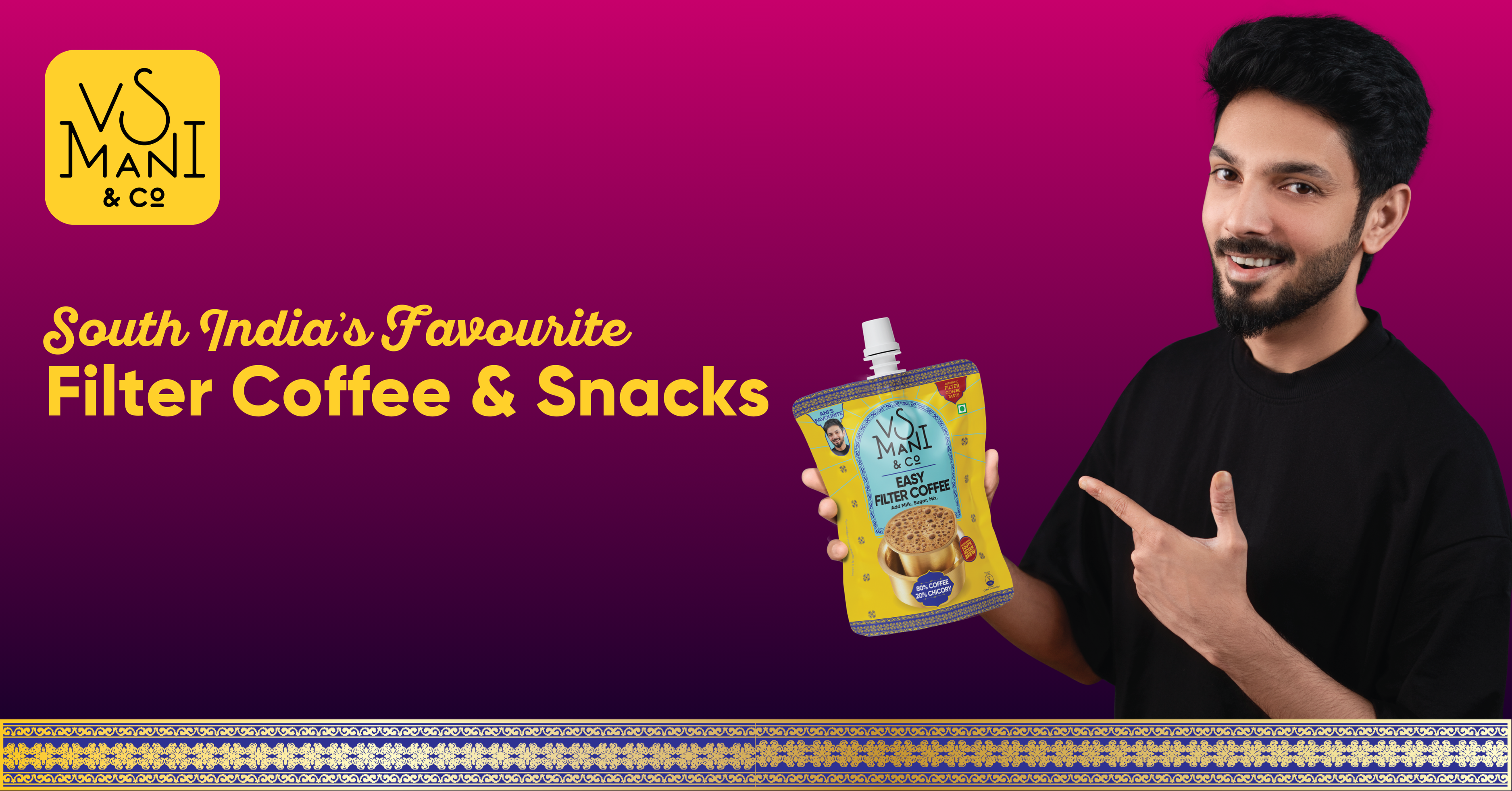

VS Mani Shark Tank India Pitch Introduction
VS Mani Shark Tank India appearance marked a watershed moment for regional specialty food brands seeking national recognition. The Bengaluru-based startup founded by former advertising executives brought authentic South Indian filter coffee and traditional snacks to the tank, capturing attention with their cultural storytelling and premium positioning. Unlike typical instant coffee brands, VS Mani & Co focused on delivering authentic decoction coffee in convenient formats alongside nostalgic snacks like murukku and banana chips.
The founders entered the tank seeking ₹60 lakhs for 1.5% equity at a ₹40 crore valuation, bold numbers that sparked intense debate among the sharks. Their pitch highlighted not merely products but a mission to become the Haldiram’s of South India, representing regional cuisine with dignity and authenticity. With monthly revenues hitting ₹63 lakhs and ambitious expansion plans, the VS Mani Shark Tank India episode demonstrated both the opportunities and challenges facing D2C food brands in competitive metropolitan markets.
Business Overview
Product Portfolio: VS Mani & Co specializes in two primary categories: authentic South Indian filter coffee decoction and traditional snacks. Their hero product, the filter coffee decoction, comes in 220ml bottles capable of producing 10-12 cups of aromatic coffee. The snack range includes murukku, banana chips, peanut chikki, and authentic podi (spice powders), all manufactured using traditional family recipes.
Problem Solved: The brand addresses a critical accessibility gap for South Indians living outside their home states. While metropolitan supermarkets stock snacks from various Indian regions, authentic South Indian filter coffee and snacks remain largely unavailable outside specialty restaurants. This forces diaspora communities to compromise on taste or rely on expensive imports.
Target Market: Primary customers include South Indian professionals aged 25-45 residing in Mumbai, Pune, Delhi NCR, Hyderabad, and Bangalore. Interestingly, the highest penetration occurs in South Mumbai and areas with concentrated South Indian populations, rather than within South India itself where local options abound.
Unique Selling Proposition: Unlike instant coffee competitors, VS Mani offers authentic decoction using traditional chicory blends. Their products command a 30% premium over mass-market alternatives, justified through superior taste profiles and cultural authenticity. The brand combines product quality with strong storytelling about South Indian food culture.
| Attribute | Details |
|---|---|
| Company Name | V S Mani & Co |
| Industry | Food & Beverage (FMCG) |
| Founded | June 2020 |
| Founders | GD Prasad, Yashas Alur, Rahul Bajaj |
| Headquarters | Bangalore, Karnataka |
| Website | vsmani.com |
About Founders
The founding team comprises three former Webchutney executives who transformed their advertising expertise into entrepreneurial action. GD Prasad, serving as Head of Growth, previously managed business development for accounts beyond Flipkart at the digital agency. His colleague Rahul Bajaj handles Operations, bringing supply chain and logistics expertise, while Yashas Alur contributes creative direction and brand strategy. Their advertising background provided crucial insights into consumer psychology, digital marketing, and brand building that differentiated VS Mani from traditional food businesses.
The trio conceived the business while working on food brand campaigns, realizing that despite India’s snacking diversity, authentic South Indian options remained absent from retail shelves. Despite not being South Indian by origin, their deep appreciation for the cuisine combined with market analysis revealed a significant opportunity. They launched operations in June 2020 during the pandemic, leveraging their digital marketing expertise to build an online-first brand before expanding into offline retail channels.
- Ex-WebChutney executives with combined 15+ years advertising experience
- GD Prasad holds 45% equity as Head of Growth and Strategy
- Rahul Bajaj manages Operations with 41% equity post angel round
- Yashas Alur drives Creative with 14% equity stake
- First-time entrepreneurs transitioning from agency to product ownership
- Deep expertise in digital performance marketing and brand storytelling
Shark’s and Founder’s QnA
Anupam Mittal questioned his prior relationship with the company and his decision to exit negotiations.
Anupam revealed he had previously invested in VS Mani through an angel round but had never physically met the founders, only communicating via phone calls. When asked about the investment amount, he declined to specify to avoid influencing the pitch dynamics. Citing conflict of interest and fairness to both the entrepreneurs and fellow sharks, he announced his withdrawal from the deal-making process despite his financial stake in the company.
Aman Gupta and Peyush Bansal inquired about the founders’ origin story and business conception.
The founders explained they met while working at Webchutney, a leading digital creative agency where they handled campaigns for various food brands including ginger chutney products. They observed that while supermarkets stocked snacks from numerous Indian regions, authentic South Indian options remained conspicuously absent from shelves. As South Indians themselves living outside their home regions, they experienced firsthand the frustration of unavailable authentic snacks and filter coffee. This personal pain point, combined with their professional brand-building expertise, motivated them to launch VS Mani in June 2020 during the pandemic.
The Sharks asked about equity distribution and individual operational roles within the founding team.
GD Prasad clarified the equity structure: he personally holds 45% of the company, Yashas Alur maintains 14%, and Rahul Bajaj owns 41% following the completion of their angel funding round. Regarding functional responsibilities, GD manages Growth and business expansion strategies while Rahul oversees Operations including supply chain and production. Yashas handles creative direction and product development initiatives. This division leverages their advertising agency experience while ensuring comprehensive coverage of all critical business functions.
Namita Thapar questioned the revenue split between their coffee and snacks categories.
The founders disclosed that coffee generates approximately 55-60% of total revenue, while snacks contribute the remaining 40%. They noted that snacks launched more recently in May, while their hero product filter coffee decoction launched on August 15th. Within just 19 days of launching the decoction product, they achieved sales of over 10,000 units, demonstrating strong product-market fit. This rapid uptake validated their strategy of expanding beyond snacks into beverages, creating a complementary product mix that encourages repeat purchases.
Vineeta Singh requested details about sales progression since the company’s inception.
The founders presented their growth trajectory starting from June 29, 2020. Financial Year 2020-21 registered merely ₹15 lakhs in revenue. The subsequent year saw significant growth reaching ₹1.2 crores. Current fiscal year projections indicated nearly ₹2 crores in sales, with ambitious targets of ₹7.5 crores for the upcoming year. The month immediately preceding their pitch showed ₹63 lakhs in revenue, demonstrating accelerating momentum and increasing consumer acceptance of their product offerings.
Aman Gupta probed into customer identification and geographic penetration patterns.
The founders identified their primary customer base as South Indians residing in metropolitan cities outside their home states, specifically targeting Mumbai, Pune, Bangalore, Hyderabad, and Delhi NCR. They observed interestingly that Mumbai’s South side showed higher penetration due to concentrated South Indian populations. They explained that while South Indian markets offered abundant local options creating less demand, the real opportunity lay in Northern and Western India where authentic options remained scarce. This diaspora-focused strategy allowed them to command premium pricing due to limited competition.
Peyush Bansal examined their pricing strategy and unit economics for the coffee products.
Regarding the 220ml bottle retailing at ₹145, the founders explained this yields approximately 10-12 cups of filter coffee, positioning the per-cup cost competitively against cafe prices while offering home convenience. They positioned this as a premium product, priced 30% higher than instant coffee competitors, justifying the cost through authentic taste profiles and quality ingredients. This pricing strategy reflected their focus on quality-conscious consumers willing to pay for authentic experiences rather than pursuing mass-market penetration through discounting.
Anupam Mittal questioned their cash burn rate and path to profitability.
The founders admitted to burning approximately ₹6 lakhs monthly despite gross revenues of ₹20-25 lakhs. They attributed this high burn rate to aggressive marketing investments and customer acquisition costs necessary for brand building. Before their current fundraising discussions, they operated at break-even levels with small profits of a couple of lakhs monthly. The increased burn resulted from aggressive digital advertising campaigns aimed at building brand awareness and capturing market share quickly before competitors could establish presence in the authentic South Indian food category.
Amit Jain inquired about their previous angel funding round specifics and valuation benchmarks.
The founders revealed they initiated funding conversations in September-November 2021, fixing a pre-money valuation of ₹15 crores. During this round, they diluted 21% equity to raise approximately ₹3.96 crores. The round officially closed in March 2022, with funds actually received in June 2022. This previous valuation set the benchmark for their current ask, though they acknowledged the significant jump to ₹40 crores valuation required justification through their demonstrated growth metrics and forward projections.
Namita Thapar questioned their marketing mix evolution and channel strategy pivots.
The founders detailed their marketing evolution, initially spending ₹10 on advertising to earn ₹30 in revenue. However, by April preceding the pitch, they observed this ratio dropping significantly, indicating rising customer acquisition costs and diminishing returns. They decided to pivot from pure online play to offline retail expansion. Currently, 85% of revenue originated from online channels including their website, Amazon, and Flipkart, but they recognized the urgent need for physical retail presence to reduce dependency on high-burn digital advertising and improve unit economics.
Namita Thapar presented her investment offer addressing their high cash burn situation.
Namita acknowledged their excessive cash burn rate and declining marketing efficiency. Respecting their previous angel round valuation of ₹15 crores, she offered ₹15 lakhs for 1% equity plus ₹45 lakhs debt at 10% interest, maintaining the same pre-money valuation they achieved previously. The founders countered, requesting recognition of their growth journey since the last round, effectively seeking a post-money valuation of ₹19 crores with the same equity terms. After brief consideration, Namita accepted the counter offer, emphasizing that profitability must become their primary focus going forward.
Amit Jain provided constructive feedback regarding their pitch narrative and valuation defense.
Following the deal closure, Amit pointed out that Namita’s initial comment about the apparent disconnect between ₹1.25 crore sales and ₹40 crore valuation had destabilized their presentation. He suggested they should have immediately countered by highlighting their ₹7.5 crore forward projection and rapid growth trajectory rather than appearing defensive. This feedback highlighted the critical importance of confidently owning one’s valuation narrative during investor presentations and immediately reframing objections around future potential rather than historical numbers.
Key Stats & Financials
The financial trajectory of VS Mani demonstrates classic D2C growth patterns with aggressive customer acquisition spending preceding monetization optimization. Their revenue growth from ₹15 lakhs to projected ₹7.5 crores within three years illustrates strong product-market fit, though profitability concerns dominated shark discussions. The deal structure ultimately reflected compromise between the founders’ growth ambitions and investor risk mitigation through debt components.
- Sales: FY21 ₹15L, FY22 ₹1.2Cr, Current Run Rate ₹7.5Cr target
- Margins: 30% premium pricing over instant coffee competitors
- Valuation: Asked ₹40 Cr, Final Deal at ₹19 Cr
- Investment Request: ₹60 Lakhs for 1.5% Equity
- Use of Funds: Offline retail expansion and reducing marketing burn
| Financial Metric | Amount |
|---|---|
| Original Ask | ₹60 Lakhs for 1.5% Equity |
| Valuation Requested | ₹40 Crores |
| Monthly Revenue (Sep 2022) | ₹63 Lakhs |
| Monthly Cash Burn | ₹6 Lakhs |
| Final Deal Value | ₹19 Lakhs Equity + ₹41 Lakhs Debt |
| Deal Valuation | ₹19 Crores |
Business Potential and TAM
The total addressable market for authentic regional Indian foods within the diaspora community presents significant expansion opportunities. With millions of South Indians living in metropolitan areas outside their home states, VS Mani addresses a culturally specific need with limited competition. The quick commerce revolution offers additional growth vectors through instant delivery partnerships.
The brand’s ambition to become the Haldiram’s of South India requires expanding beyond current SKUs into comprehensive meal solutions and RTE categories. Their 30% repeat purchase rate for coffee indicates strong retention potential, while the snacks category offers higher margins and impulse purchase opportunities through retail channels.
- Addressable market of 100+ million South Indians living outside home states
- Growing appreciation for authentic regional cuisines among non-South Indian consumers
- Quick commerce channels enabling instant gratification for snack cravings
- Export potential to Southeast Asian and Middle Eastern diaspora markets
VS Mani: Ideal Target Audience & Demographics
| Demographic | Details |
|---|---|
| Primary Geography | Mumbai, Pune, Bangalore, Hyderabad, Delhi NCR |
| Ethnic Background | South Indians (Tamil, Telugu, Kannada, Malayali) |
| Age Group | 25-45 years working professionals |
| Income Level | ₹8+ Lakhs per annum |
| Psychographics | Nostalgia seekers, authenticity focused |
| Pain Point | Missing home flavors in urban settings |
Marketing and Distribution Strategy
VS Mani’s marketing strategy reflects their advertising background, emphasizing digital storytelling and Instagram branding over traditional retail marketing. Initially, they maintained a 1:3 ratio of marketing spend to revenue, an aggressive approach that built brand awareness but proved unsustainable as CAC increased. Their pivot toward offline retail aims to reduce dependency on paid acquisition while increasing impulse purchases.
The distribution evolution moves from pure D2C website sales to marketplace platforms including Amazon and Flipkart, with recent expansion into quick commerce channels like Blinkit and Zepto. This omnichannel approach addresses different consumption occasions, from planned monthly coffee subscriptions to immediate snack cravings.
- Instagram-first branding strategy leveraging visual food aesthetics
- Transition from 85% online revenue to omnichannel distribution
- Quick commerce partnerships for instant gratification marketing
- Pop-up experiences combining food with South Indian culture events
- Retail expansion targeting South Indian dominated neighborhoods
V S Mani Deal Outcome
Despite initial skepticism regarding the ₹40 crore valuation, VS Mani secured investment from Namita Thapar, who recognized the brand’s cultural authenticity and market positioning. The final deal structure reflected a compromise that protected investor downside while giving founders capital for growth.
Anupam Mittal exited negotiations due to prior investment, while Aman Gupta, Peyush Bansal, Vineeta Singh, and Amit Jain declined citing high cash burn rates and disconnected valuation metrics. Namita’s offer acknowledged the previous angel round valuation while providing necessary growth capital through a combination of equity and debt.
| Deal Component | Details |
|---|---|
| Investing Shark | Namita Thapar |
| Equity Investment | ₹19 Lakhs for 1% Equity |
| Debt Component | ₹41 Lakhs at 10% Interest |
| Effective Valuation | ₹19 Crores (Pre-money) |
| Other Sharks | All opted out |
| Deal Status | Accepted by Founders |
V S Mani Post-Show Update
Following their Shark Tank India appearance, VS Mani experienced significant brand awareness growth across Indian metropolitan markets. The association with Namita Thapar provided credibility that facilitated retail expansion discussions. The company leveraged the publicity to strengthen their quick commerce presence and expand their retail footprint in Bangalore and Mumbai.
The founders focused on optimizing their marketing spend to achieve profitability, addressing the cash burn concerns raised during the pitch. Their appearance served as a cultural moment for South Indian food brands, inspiring similar regional specialty companies to pursue national scaling strategies.
Business Analysis & Lessons
The VS Mani pitch offers crucial lessons for D2C founders regarding valuation justification and narrative control. The disconnect between their ₹1.2 crore trailing revenue and ₹40 crore ask created immediate skepticism, demonstrating the importance of either justifying valuations through forward projections or adjusting expectations to match current metrics.
The deal structure itself illustrates creative solutions for high-burn startups, combining equity with debt to balance growth capital needs against investor risk. Namita’s decision to respect the previous round’s valuation while adding debt terms provided a template for evaluating companies with recent funding history.
- Valuation narratives must align with revenue multiples or growth trajectories
- High cash burn requires clear path to profitability presentation
- Previous funding rounds establish valuation floors for new investors
- Product-market fit evidenced by 30% repeat rates validates retention
- Cultural storytelling can command premium pricing in food categories
Pitch Conclusion
The VS Mani Shark Tank India episode exemplifies the challenges facing regional specialty brands seeking national scaling capital. While the founders’ advertising background provided strong storytelling capabilities, their financial projections and cash burn rates required defense against skeptical investors. The eventual deal with Namita Thapar validates the underlying business model while providing necessary oversight regarding capital efficiency.
For entrepreneurs watching the pitch, the key takeaway centers on valuation justification during investor presentations. Having a clear narrative that connects historical performance to future potential, while addressing unit economics concerns proactively, proves essential for securing favorable terms. VS Mani’s journey from a ₹15 lakh startup to a ₹19 crore valued brand within three years demonstrates the potential for culturally authentic products in India’s fragmented food market.