



Pitch Introduction
In the bustling Indian food and beverage market, replicating professional, café-grade coffee in the comfort of one’s home continues to be a severe challenge. In Season 4, Episode 29, the sibling entrepreneurs Sheena and Karan stepped onto the grand stage to pitch their brand, Zenma Coffee Shark Tank India. They presented an innovative, flash-frozen liquid espresso pod that promises to remake the domestic coffee landscape. By offering café-quality shots on demand, they hoped to win over the board with their vision of accessible luxury.
Entering with high energy, the founders targeted the massive space between low-cost but flavorless instant powder and expensive, high-maintenance espresso machines. The pitchers pitched a premium solution to simplify morning routines across metros. They requested an investment of ₹60 Lakhs in exchange for a 3.5% equity stake in the company, placing their valuation at ₹17.14 Crores. This started a detailed evaluation of their cold chain delivery model, unit economics, and general market scope.
Business Overview
Zenma Coffee was founded in 2023 in Gurugram to tackle a persistent challenge: brewing authentic fresh espresso easily. While global coffee shops have boomed across metropolitan cities, domestic consumers still struggle with the inconvenience of grinding beans. For many, high-end pod machines priced over ₹15,000 are too expensive, keeping them dependent on low-grade, freeze-dried instant powder formulas.
To solve this, Zenma Coffee created a unique frozen liquid espresso system. By brewing pure espresso and freezing it instantly, the brand locks in the volatile aromatics that usually escape when hot coffee is left to oxidize. The frozen pods can be stored for up to a year, containing no preservatives, flavor enhancers, or chemical stabilizers.
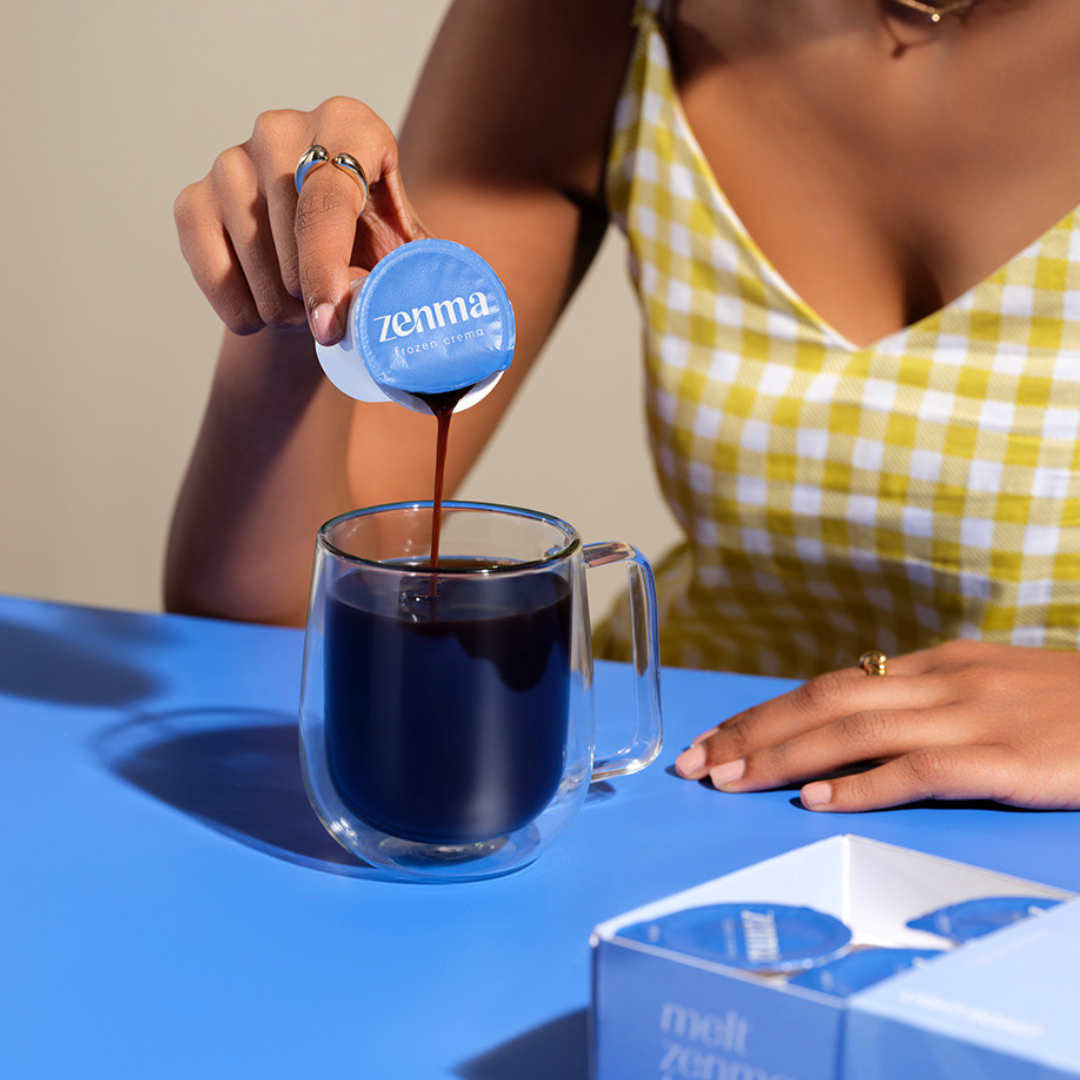
The preparation is built entirely around convenience. A consumer takes a pod from the freezer, removes the peel, and melts the frozen espresso in a microwave for 30 seconds. The resulting liquid shot can be combined with hot milk, iced water, or warm water to create flat whites, Americanos, or lattes on demand. This system targets high-convenience consumer demographics who desire quick access to luxury products.
Product Details
Zenma Coffee currently sells four different product variants to cater to varying consumer roast preferences: Light Roast, Medium Roast, Dark Roast, and Mocha. The central secret to their product’s premium profile lies in their specialized flash-freezing technology. Freshly extracted liquid espresso, containing its natural oily crema layer, is subjected to sub-zero temperatures immediately after extraction to lock in flavor compounds.
Market Position
The company positions itself at the top tier of home-brewed products, hoping to attract quality-seeking consumers who find traditional instant options lacking. At approximately ₹50 per single pod, they are more expensive than domestic instant choices (which cost ₹8 to ₹20 per cup) but offer a more affordable luxury compared to modern café cups priced at ₹250. Their main competitive edge is providing automated espresso-machine taste without the actual equipment expense.
| Business Detail | Information |
|---|---|
| Company Name | Zenma Coffee |
| Founder | Sheena and Karan |
| Product Type | Flash Frozen Liquid Espresso Pods |
| Price Range | ₹599 per box (approx. ₹50 per shot) |
| Primary Channel | Direct-to-Consumer & Quick Commerce |
| Headquarters | Gurugram, Haryana |
About Founder’s
The corporate foundation of Zenma Coffee lies in the complementary professional background of its founders, operating out of Gurugram. Sheena studied Economics at Delhi College of Arts and Commerce before spending four years in the institutional sector working in real estate private equity at Hines. Driven by her passion for specialty beverages, she quit her position, invested her personal savings, and moved to Rome, Italy, to secure a formal barista training certification.
Her brother Karan, an alumnus of St. Stephen’s College where he studied Economics, joined her entrepreneurial venture soon after. Initially, the duo launched 16 Grams in 2019, operationalizing physical kiosks in corporate settings. After navigating the complications of the pandemic, they pivoted to online shipping of roasted coffee beans. This close relationship with consumers eventually inspired their flash-frozen format in late 2023. According to The Indian Express, the founders got creative backup from clear family channels, which helped them develop the product through its initial stages.
- Sheena holds an Economics degree and formerly worked at Hines.
- Karan holds an Economics degree from St. Stephen’s College.
- The sibling duo previously founded coffee brand 16 Grams in 2019.
- Sheena went to Rome, Italy, for professional barista training.
Shark’s and Founder’s Q&A
What is your background and what motivated you to build Zenma Coffee?
We are Sheena and Karan, a brother-sister duo from Delhi. Sheena studied economics at DCAC and worked in real estate private equity for four years, while Karan studied economics at St. Stephen’s. We wanted to address the poor quality of home-brewed coffee in North India. Sheena spent her savings to complete a barista training course in Rome, where she discovered how highly Indian coffee beans are valued abroad, yet we drink instant coffee of low quality back home.
How did you transition from a physical coffee store to this frozen espresso format?
In 2019, we opened a small coffee kiosk named 16 Grams inside the office building where Sheena used to work. But because we were a bootstrapped business, we had to close the physical location and shift completely online to selling coffee beans and grounds during COVID. We found that customers stopped using machines because processing beans took too much effort. This feedback prompted us to look for a convenient way to bring espresso home.
What inspired you to adopt this specific frozen pod format?
Outside India, we looked at brands like Cometeer in the United States, who raise significant capital with liquid espresso concentrates. Our recipe and preparation flow is unique because we focus on flash freezing. This locks in the crema layer, preserving the fresh espresso aroma without synthetic preservatives. High-fidelity coffee requires a low thermal state to retain chemical stability.
Why call the product “frozen crema” and how does the consumer use it?
We call it frozen crema because the top frothy layer of an espresso shot is called crema. For people who don’t know us, it sparks curiosity. To consume it, you take a capsule from the freezer, place it in the microwave for 30 to 40 seconds to melt, and then mix the liquid with either hot or cold milk or water. It stays stable in a normal refrigerator for 10 days, but must be kept frozen for long-term storage up to a year.
What are your current monthly sales figures and channel split?
In our first financial period from September 2023 to March, we did a minor revenue run rate. By May, we hit ₹3.5 Lakhs. For September, our monthly revenue reached ₹8 Lakhs. Our channel distribution split is 88% direct-to-consumer via our website, 10% through quick commerce channels, and just 2% from localized business-to-business avenues.
What are your unit economics and how do you justify your pricing?
A package of cards costs ₹599 which contains several pods, bringing the average cost to ₹50 per single espresso shot. After standard discounts and net realizations, we retain ₹450 per box. Our Cost of Goods Sold is ₹275 per box. Shipping costs ₹66, transaction processing costs ₹12, and marketing costs ₹100. This structure results in short-term cash burn, leading to a net loss of ₹10 Lakhs during high-spend months.
Key Stats & Financials
Zenma Coffee’s operational financials revealed a business facing significant early-stage cash burn to grow its user base. They pitched a unique category, yet their financials showed higher expenditures compared to their overall scale.
Revenue and Profitability
- Lifetime Sales: Accumulated revenue of over ₹51 Lakhs through their historical brand iterations.
- Profit Margins: High unit cost structure with a gross realization of roughly 40% after discounts.
- Valuation: The founders sought ₹60 Lakhs in exchange for 3.5% equity, valuing the startup at ₹17.14 Crores.
- Prior Investment: Secured ₹1.25 Crores in an external round in June to accelerate quick commerce pilots.
- Monthly Cash Burn: Experiencing a recurring net loss of ₹10 Lakhs during their peak marketing months.
Financial Breakdown
| Metric | Amount / Value | ₹8 Lakhs
| ₹275
| ₹450
| ₹66
| ₹1.25 Crores
| ₹51 Lakhs |
|---|
Business Potential and TAM
Analyzing the long-term prospects of Zenma Coffee requires looking at the broader domestic beverage space in India. The aggregate Indian coffee industry represents a valuation of approximately ₹9,000 Crores. Within this landscape, domestic home consumption captures a massive ₹6,000 Crores. Out of this at-home segment, premium coffee brands make up approximately 30% of the market, translating into a Total Addressable Market of ₹1,800 Crores to ₹2,000 Crores.
While this premium segment represents notable commercial potential, it is highly niche and heavily localized within Tier 1 metropolises. According to Inc42, specialty choices on-the-go are seeing interest as young consumer dynamics evolve, yet high supply-chain dependencies present serious expansion limitations.
Market Size Analysis
Though the total size of the premium segment reaches ₹2,000 Crores, the immediate serviceable market is restricted. Due to cold store limits, the enterprise is constrained to metros with advanced cold chain logistics, like Delhi, Mumbai, and Bengaluru. This limits active penetration, as other states lack the fast cooling networks required to transport frozen item pods without risk of melting.
Growth Opportunities
- B2B Offices Partnerships: Distributing to premium offices and co-working units looking for high-quality café options.
- Quick Commerce Integration: Utilizing dark store networks in key cities to deliver frozen packages in under 15 minutes.
- Shelf-Stable Concentrates: Developing non-frozen liquid alternatives to bypass cold chain shipment issues.
- Global Niche Exports: Introducing high-margin single-serve options to mature international regions like the Middle East.
Zenma Coffee: Ideal Target Audience & Demographics
| Demographic | Details |
|---|---|
| Primary Age Group | 22 to 36 years |
| Secondary Age Group | 37 to 50 years |
| Interests | Specialty brewing, gourmet foods, convenience products |
| Platform Preference | Instagram, YouTube, and LinkedIn |
| Geography | Tier 1 Indian Metros (Mumbai, Delhi-NCR, Bengaluru) |
| Buying Behavior | High frequency, subscription-focused, premium choice |
Marketing and Distribution Strategy
Zenma Coffee faces a double challenge: selling a premium product while educating mass consumers on a new product format. Unlike established powder options, their liquid shots require a distinct cold logistics chain.
Customer Acquisition
The company relies closely on digital performance marketing to reach consumers. However, acquisition remains expensive, with marketing costs accounting for ₹100 per sold unit. This high CAC puts pressure on their gross margins, requiring them to convert first-time buyers into long-term subscribers to achieve profitability.
Distribution Channels
- Direct D2C Portal: Driving automated repeat orders through recurring online memberships.
- Hyperlocal Networks: Shipping through online channels inside regional centers.
- Corporate Kiosks: Using office relationships to place easy dispenser formats.
- Experience Pop-ups: Placing active tasting boots in premium retail spaces to attract direct buyers.
Social Media and Content Strategy
Their online strategy focuses on visual and aesthetic appeal, highlighting the sensory process of pouring warm milk over a melting crema shot. By keeping their styling clean and premium, they hope to make Zenma Coffee a lifestyle choice rather than just a daily drink.
Zenma Coffee Shark Tank Deal Outcome
In the Tank, the sharks raised concerns regarding cold logistics, market size, and customer retention. [Aman Gupta](/shark/aman-gupta/) noted he was a traditional instant drinker and didn’t see the value of paying a premium for domestic brewing. [Anupam Mittal](/shark/anupam-mittal/) and [Vineeta Singh](/shark/vineeta-singh/) agreed that temperature shifts during general transport could ruin product quality. Due to the high asset costs and the niche market, the founders left with No Deal.
| Shark | Offer Detail |
|---|---|
| [Aman Gupta](/shark/aman-gupta/) | Out. Enjoys basic instant options and found the price steep. |
| [Anupam Mittal](/shark/anupam-mittal/) | Out. Believes the frozen format creates storage friction. |
| [Vineeta Singh](/shark/vineeta-singh/) | Out. Advised against pursuing a capital-heavy niche business. |
| [Peyush Bansal](/shark/peyush-bansal/) | Out. Warned of transport risks in India’s complex climate. |
| [Kunal Bahl](/shark/kunal-bahl/) | Out. Expressed concern over high marketing costs and low retention. |
| Final Decision | No Deal. The team walked away with feedback but no investment. |
Zenma Coffee Post-Show Update
While the founders did not secure active programmatic investment on the show floor, the visual marketing of their premium coffee model triggered a notable rise in organic online search across metro cities. According to Inc42, Zenma Coffee was featured on the list of “30 Startups to Watch” following their visual showcase, which brought key industry partnerships to light. Verified post-show updates for Zenma Coffee are not yet available. We will update this section as reliable information is published.
Business Analysis & Lessons
The interaction highlights how innovative product development can hit unexpected limits when facing logistics and market realities. While creating an advanced format is an achievement, managing a sub-zero cold supply chain in a major metropolitan country comes with high real-world costs.
For Zenma Coffee, calling their product “frozen crema” created unexpected consumer confusion. Rather than focusing purely on convenience, the founders had to explain how to store and melt the pods, while justifying a pricing structure that sits far above mass-market alternatives.
Key Takeaways
- Category Creation Limits: Novel product types demand significant educational marketing before achieving mass adoption.
- Cold Chain Complexity: Cold distribution in temperate countries comes with high logistics risks and high return rates.
- Address Product Friction: A drink requiring a microwave or freezer is limited in terms of travel and office convenience.
- Focus on Institutional Niches: For premium brands, corporate partnerships often yield stronger unit stability than DTC retail.
Pitch Conclusion
The journey of Sheena and Karan with Zenma Coffee shows how specialized innovation must find a balance with distribution costs to survive on a venture scale. While they left the stage without a deal, their specialized approach highlights an evolving direction for the Indian beverage sector.
If you enjoyed this breakdown, check out Toffee Coffee Roasters, Go DESi, and NOCD.
[faq_accordian]