


Pitch Introduction
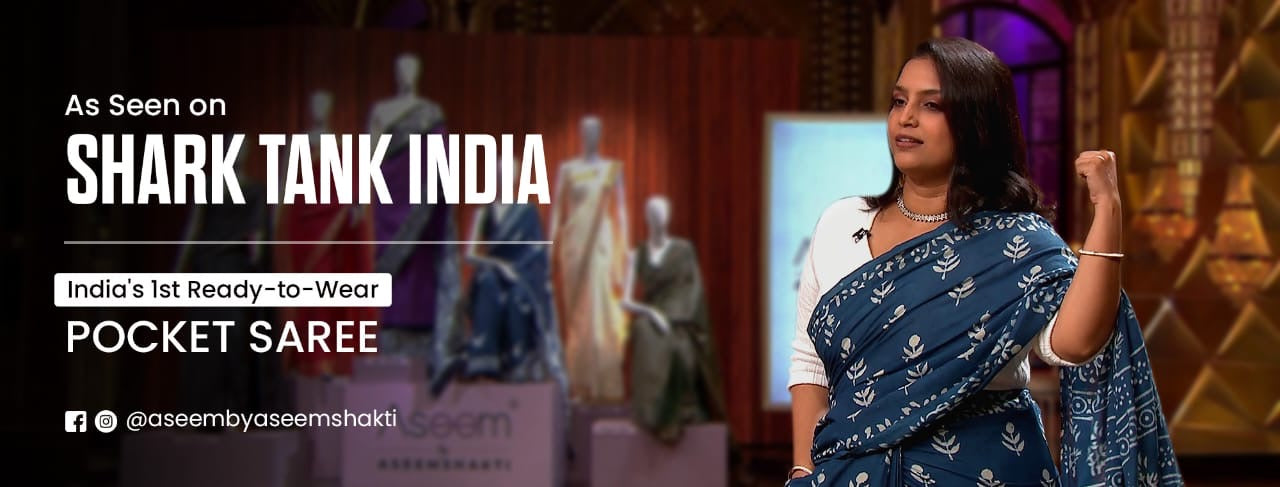
The Aseem Shakti Shark Tank India pitch brought a refreshing blend of social impact and fashion innovation to the tank. Founder Swati walked into Season 4 with a solution to India’s oldest fashion struggle: the complexity of draping a saree. Describing the garment as a “two-person job” that often requires help from neighbors or professionals, Swati introduced Aseem by Aseem Shakti, a brand that simplifies the saree into a 15-second wear-and-go outfit. With a powerful backstory involving the empowerment of women from low-income families, the pitch immediately resonated with the Sharks, leading to one of the most emotional and visually memorable moments of the season.
Business Overview
Aseem Shakti is a Mumbai-based fashion brand that specializes in ready-to-wear sarees designed for the modern, independent woman. The company’s core mission is to remove the “tension” from tradition by making sarees as easy to wear as a T-shirt. By eliminating the need for a petticoat and safety pins, the brand allows women to move comfortably, even suggesting that they can wear shorts or leggings underneath. Since its incorporation in 2018, the business has grown from a local initiative into a digital-first brand with a strong presence on social media and major marketplaces.
The business operates as a social enterprise, employing women from marginalized backgrounds who were previously involved in high-risk cosmetic patch testing to earn a living. By training these women in sewing and garment construction, Swati has created a workforce that produces high-quality traditional wear while earning sustainable wages. This dual focus on product innovation and social upliftment defines the brand’s identity in the competitive Indian ethnic wear market.
Product Details
The flagship product is the 15-second saree, which features a pre-stitched lining and a custom-fit design based on the customer’s height and waist size. The most discussed feature is the “magical pocket,” a deep, concealed pocket capable of holding essentials like smartphones, keys, lipsticks, and even small documents without ruining the saree’s silhouette. This functional addition addresses a long-standing grievance in women’s traditional attire. The sarees are priced between ₹3,100 and ₹6,000, targeting the mid-premium segment of the market.
Market Position
Aseem Shakti positions itself as a problem-solver in the ethnic wear space. While many brands focus solely on aesthetics, Swati’s brand focuses on utility and ease of use. By targeting working professionals, travelers, and women attending social events, the brand taps into the growing “fusion wear” and “ready-to-wear” trends in India. Its USP lies in the combination of a pocket-friendly design (literally and figuratively) and a meaningful social cause that attracts conscious consumers.
| Business Detail | Information |
|---|---|
| Company Name | Aseem Shakti |
| Founder | Swati |
| Product Type | Ready-to-wear Ethnic Fashion |
| Price Range | ₹3,100 to ₹6,000 |
| Primary Channel | Direct-to-Consumer (Website) |
| Headquarters | Mumbai, Maharashtra |
About Founder’s
Swati, the founder of Aseem Shakti, has a background in education and social work. Before starting her business, she taught spoken English to underprivileged youth and was a UPSC aspirant. It was during her UPSC studies that she learned about self-help groups and decided to organize women in her neighborhood to solve financial distress. Her journey into fashion began when she discovered the dangerous risks her neighbors took—participating in high-risk human testing for cosmetics—to support their families.
- Formerly a teacher for underprivileged youth in Mumbai.
- Organized “Pushpa and the Gang” to create a community-driven economic model.
- Pivoted from food business ideas to fashion after identifying the ready-to-wear saree gap.
- Scaled the business through viral marketing, including a famous video featuring a foreign traveler.
Shark’s and Founder’s QnA
How did you start this business?
I started by organizing a self-help group in my home because money is the biggest problem in low-income families. I saw my neighbors coming back with bandages on their backs from cosmetic patch testing—basically human testing for money. I thought it was very dangerous. I knew sewing and knitting, so we decided to try fashion. In 2018, we officially launched to make ready-to-wear sarees.
What were your sales in the last few years?
Last year we did ₹65 Lakhs. The year before that was ₹22 Lakhs, and ₹19 Lakhs before that. This year, from April until now, we have already done ₹1.3 Crores. Last month alone (September), we achieved sales of ₹28 Lakhs.
How much profit are you making?
Our net margin is around 20%. For example, in September, on ₹28 Lakhs of sales, we had a profit of about ₹4 Lakhs after distributing payments to the women and covering costs. We are quite healthy in terms of profitability for a bootstrapped brand.
How many women are you empowering?
There are 18 people in my unit and I have outsourced work to an NGO. In total, 35 women are working with us. We pay them ₹300 per saree. Last month, the highest an artisan earned was ₹44,000, with the average being around ₹30,000. It’s a significant change for their families.
What is the cost of making one saree?
The cost of the saree fabric we buy is about ₹720 including GST. We pay ₹300 for labor. While the Sharks think the markup to ₹3,100 is high, we have other operational costs like our rented unit in Mumbai and marketing.
What is your vision for the company?
I want to build a ₹100 Crore company in the next two to three years. I want to bring these sarees to every boardroom, dinner date, and festival in the world. I want to prove that a social enterprise can also be a massive, profitable business.
Key Stats & Financials
Aseem Shakti demonstrated impressive growth for a founder-led social enterprise. The jump from ₹65 Lakhs to a run rate that exceeded ₹1.3 Crores within half a year showed significant market traction. The brand has sold over 10,000 sarees to date, primarily through its own website.
Revenue and Profitability
- Lifetime Sales: Over 10,000 sarees sold.
- Profit Margins: 20% Net Margin reported.
- Valuation: Asked for ₹20 Crores; settled at ₹5 Crores.
- Investment Request: ₹50 Lakhs for 2.5% equity.
- Monthly Burn: Not disclosed, but the business is profitable.
Financial Breakdown
| Metric | Amount / Value |
|---|---|
| FY 2022-23 Sales | ₹22 Lakhs |
| FY 2023-24 Sales | ₹65 Lakhs |
| Current Year (Partial) | ₹1.3 Crores |
| Monthly Sales (Sept) | ₹28 Lakhs |
| Production Cost (COGS) | ₹1,020 (Approx) |
| Average Retail Price | ₹3,500 |
Business Potential and TAM
The potential for Aseem Shakti Shark Tank India lies in the massive Indian ethnic wear market, which is projected to reach over $30 Billion by 2025. Within this, the ready-to-wear or “pre-stitched” saree segment is the fastest-growing sub-sector. Modern Indian women are increasingly looking for convenience without sacrificing cultural heritage. The brand’s focus on functional features like pockets and ease of wear taps into a demographic of working women who previously found sarees too cumbersome for daily office use.
Market Size Analysis
The total addressable market (TAM) for sarees in India is enormous, but the specific market for functional, ready-to-wear sarees is currently estimated at ₹5,000 Crores and growing at a CAGR of 15%. As more women enter the workforce and global travel becomes common, the demand for sarees that don’t require external assistance or excessive pinning is set to explode. Furthermore, the global Indian diaspora represents a high-margin opportunity for international shipping.
Growth Opportunities
- Marketplace Expansion: Launching on Myntra, Ajio, and Nykaa Fashion to reach millions of shoppers.
- Backward Integration: Manufacturing fabric in-house to reduce costs from ₹720 to lower levels.
- International Shipping: Targeting the NRIs in the USA, UK, and UAE who struggle with traditional draping.
- Corporate Gifting: Partnering with companies for uniform sarees or festive gifting for employees.
Aseem Shakti: Ideal Target Audience & Demographics
| Demographic | Details |
|---|---|
| Primary Age Group | 25 – 45 Years |
| Secondary Age Group | 45 – 60 Years (Ease of use) |
| Interests | Traditional Wear, Career-oriented, Travel |
| Platform Preference | Instagram and Myntra |
| Geography | Tier 1 and Tier 2 Cities | Occasion-based and Festive shopping |
Marketing and Distribution Strategy
Aseem Shakti began as a word-of-mouth initiative but pivoted to a digital-first strategy. Initially taking orders through WhatsApp and Instagram, the brand transitioned to its own e-commerce website in 2023. This move allowed them to run targeted Meta ads, which now drive 95% of their sales. The founder’s resourceful nature was highlighted by her story of meeting a traveler on a Mumbai local train and convincing her to model for a viral video that kickstarted their growth.
Customer Acquisition
The primary customer acquisition channel is Meta Ads (Facebook/Instagram). By showcasing the 15-second draping process through reels, the brand achieves high engagement rates. While the specific CAC wasn’t detailed, the 20% net margin suggests an efficient marketing spend relative to the average order value of over ₹3,500.
Distribution Channels
- Own Website: Contributes the majority of current revenue.
- Social Media: High conversion via Instagram DMs and WhatsApp catalogues.
- Marketplaces: Recently launched on Myntra to tap into a broader audience.
- Offline Events: Participation in high-end exhibitions and pop-up stores in Mumbai.
Social Media and Content Strategy
The brand’s content strategy revolves around demonstration. Videos showing the “magical pocket” holding multiple items—from phones to medicines—have gone viral multiple times. This visual proof of utility is more effective than traditional fashion photography in convincing customers of the brand’s value proposition.
Aseem Shakti Shark Tank Deal Outcome
The negotiation was intense, with most Sharks being impressed by the mission but worried about the founder’s lack of financial depth and business systems. Namita Thapar praised the “perfect blend of tradition,” but opted out. However, Anupam Mittal saw the potential in the leadership and the mission. In a dramatic moment, Anupam even draped a saree himself to test the product before making a “Lion” offer.
| Shark | Offer Detail |
|---|---|
| Anupam Mittal | Invested ₹50 Lakhs for 10% Equity |
| Peyush Bansal | Out – Wanted more focus on unit economics and scale foundation. |
| Namita Thapar | Out – Concerned about the execution level. |
| Vineeta Singh | Out – Felt consumer value wasn’t high enough vs regular sarees. |
| Final Decision | Accepted Anupam’s offer |
Aseem Shakti Post-Show Update
Following the episode, Aseem Shakti gained massive traction on social media. According to The Times of India, Anupam Mittal’s gesture of draping the saree became a viral highlight, significantly boosting the brand’s visibility. Livemint reported that the brand’s “15-second saree” innovation is seen as a game-changer in the ethnic wear space. Since the airing, the brand has seen a surge in orders, and Swati is working closely with Anupam’s team to professionalize her marketing and finance departments.
Business Analysis & Lessons
The Aseem Shakti Shark Tank India pitch is a classic example of a social enterprise finding a scalable product-market fit. Swati’s strength lies in her authentic connection to the workforce and the problem she is solving. However, the Sharks correctly pointed out that “passion” and “mission” must be supported by “MIS” and “financial systems” to reach the ₹100 Crore milestone. The business model of using self-help groups is noble but requires rigorous quality control and standardization to scale.
For other entrepreneurs, Aseem Shakti offers a lesson in resourcefulness. From creating viral videos with strangers to building a profitable brand while bootstrapped, Swati proved that capital isn’t always the first requirement for success. Her focus on one specific, high-value feature (the pocket) gave her a clear marketing hook that larger, more established brands lacked.
Key Takeaways
- Utility over Aesthetics: Adding a functional feature like a pocket to a traditional garment can create a powerful USP.
- Mission-Driven Marketing: Customers connect with the story of the women behind the product, which can lead to lower acquisition costs.
- Financial Literacy: Founders must have a deep understanding of their unit economics (₹720 cost vs ₹3,100 price) to negotiate effectively with investors.
- Strategic Partnerships: Bringing in an investor like Anupam Mittal, who can provide marketing and finance professionals, is often more valuable than the cash itself.
Pitch Conclusion
Swati’s journey with Aseem Shakti is a testament to the power of combining tradition with modern convenience. By securing a deal with Anupam Mittal, she has positioned her social enterprise for rapid growth. If you enjoyed this breakdown, check out Pabiben, LittleBox, and YesMadam.
[faq_accordian]