



Pitch Introduction
The Woodsmen Shark Tank India pitch stands out as one of the most high-stakes presentations in the show’s history. Founder Shivam Ginglani walked into the tank with a massive ask of ₹1.5 Crores for 0.5% equity, effectively valuing his liquor startup at a staggering ₹300 Crores. This valuation was so high that Aman Gupta humorously asked if the founder was high on his own supply. However, the humor quickly turned into respect as Shivam revealed that his brand has already achieved ₹125 Crores in gross revenue in just three years of operations.
Business Overview
Woodsmen, under the parent company Ginglani Distillers, is positioning itself as India’s first “Himalayan Whiskey.” The brand aims to disrupt the stagnant Indian-made foreign liquor (IMFL) market, which has been dominated by legacy brands for decades. By focusing on the purity of Himalayan water and locally sourced barley, the company offers a smoother drinking experience compared to traditional entry-level and mid-range whiskeys.
The business operates on a heavy retail distribution model, primarily focusing on North India. Shivam’s strategy is built on the insight that while the Indian whiskey market is massive, the branding at the ₹500 to ₹1000 price point has remained dated since the 1980s. Woodsmen fills this gap with modern packaging and a clear regional identity that resonates with the new-age Indian consumer.
Product Details
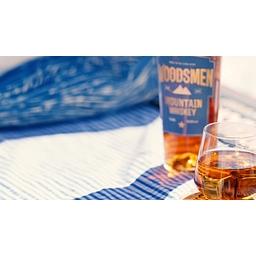
The core product line includes the Woodsmen Extra Smooth Whiskey and the premium Himalayan Whiskey. A key differentiator is the physical design of the bottle; the company holds a patent for a bottle that features a 3D mountain embossed at the base. The whiskey is available in four standard sizes: 90 ml, 180 ml, 375 ml, and 750 ml. By using Himalayan water, which constitutes 60% of the spirit, the brand achieves a naturally light-bodied and palatable profile that lacks the harsh “throat burn” often associated with cheaper alternatives.
Market Position
Woodsmen competes in the highly competitive IMFL (Indian-made foreign liquor) category. Its primary rivals are legacy giants like Royal Stag and Blenders Pride. However, Woodsmen carves its niche by offering a 12% premium positioning over basic entry-level whiskeys. It targets the semi-premium segment, where consumers are looking for a “step up” in quality without the massive price jump to international Scotch brands. The brand is currently dominant in Delhi, Chandigarh, Haryana, and Himachal Pradesh.
| Business Detail | Information |
|---|---|
| Company Name | Woodsmen (Ginglani Distillers) |
| Founder | Shivam Ginglani |
| Product Type | Himalayan Whiskey |
| Price Range | ₹560 to ₹1600 (750ml) |
| Primary Channel | Retail Wine Shops (L1/L2) |
| Headquarters | Delhi, Delhi |
About Founder’s
Shivam Ginglani is a highly educated entrepreneur with a background that combines economics and finance. He completed his Economics Honours from Ramjas College, Delhi University, before pursuing a Masters in Finance and Business Economics from Manchester Business School in 2013. According to his LinkedIn profile, Shivam spent years researching the liquor industry from the ground up, even traveling on distributor bikes to understand retail psychology.
- He started with agricultural exports before realizing his passion for brand building.
- Spent significant time in Daman and Goa conducting pilot runs to understand production mistakes.
- Personally visited hundreds of retail shops to study consumer behavior at the point of sale.
- Managed to raise capital from high-profile investors like the former Chairman of Coca-Cola Asia Pacific and the founders of Bombay Shaving Company.
Shark’s and Founder’s QnA
Aman Gupta asked if you were drunk after hearing the ₹300 Crore valuation. How do you justify this number?
I understand the shock, but we have done gross sales of ₹120 Crores to date. Last year our gross was ₹49.5 Crores and this year we are targeting ₹80 Crores. I am raising a round in the market right now at this exact valuation because our growth and distribution depth in North India justify it.
You mentioned you sold 50 Lakh bottles. What is the unit economics of a bottle?
Our gross margin is 46%. For our main product priced at ₹560 in Delhi, the distribution cost is 25%, marketing is 6%, and employee benefits are around 6%. Last month, we were actually EBITDA positive at 5%. We are improving margins as we gain scale in blending and sourcing.
What makes your whiskey “Himalayan” and why does it matter?
Whiskey is 60% water. We make Woodsmen in the valleys of Himachal using Himalayan water and barley. People already pay a premium for Himalayan bottled water; they naturally understand that pure water leads to a smoother, better-tasting spirit. It is an easy brand promise for the consumer to grasp in under five seconds.
Why are legacy brands not doing what you are doing?
Large brands at massive scales focus heavily on P&L and cost-cutting. They often rush the blending process. We follow a strict SOP and don’t rush. Our Extra Smooth whiskey is a step up for the consumer who is tired of the same old brands that have been in the market for 30 years.
How much capital have you raised before coming to Shark Tank?
We raised ₹4.6 Crores in 2021 at a ₹50 Crore valuation. Then in November 2023, we raised ₹12.5 Crores at a pre-money valuation of ₹120 Crores. Our investors include family offices and founders of top D2C brands like Epigamia and Country Delight.
Are you here just for marketing or do you actually want a deal?
I am being honest; Shark Tank is a massive national stage for Woodsmen. But I am also here to kickstart my current funding round. I am looking for the right set of investors who can provide input as we scale nationally. Even though I am asking for a high valuation, it’s what the market is currently discussing for us.
Key Stats & Financials
The financial performance of Woodsmen Shark Tank India pitch was remarkably strong for a startup in a regulated industry. The company demonstrated a clear path toward profitability despite the heavy capital requirements of the liquor trade.
Revenue and Profitability
- Lifetime Gross Sales: ₹125 Crores
- Gross Margin: 46% (Targeting 50% by March)
- Requested Valuation: ₹300 Crores
- Projected Revenue (FY24-25): ₹80 Crores (Gross), ₹33 Crores (Net)
- Current Burn: Recently achieved monthly EBITDA break-even
Financial Breakdown
| Metric | Amount / Value |
|---|---|
| FY 22-23 Net Revenue | ₹3.2 Crores |
| FY 23-24 Net Revenue | ₹17 Crores |
| FY 24-25 Projected Net | ₹33 Crores |
| Last Year Loss | ₹4 Crores | ₹11 Crores |
| Marketing Cost | 6% of Net Sales |
Business Potential and TAM
The business potential for Woodsmen is anchored in the massive Indian alcohol market, which is valued at over ₹5 Lakh Crores annually. Within this, whiskey is the undisputed king, accounting for more than 65% of the total volume. India is currently the world’s largest consumer of whiskey by volume, yet the market is heavily skewed toward “Indian-made foreign whiskey” (IMFL) that often lacks a premium regional identity. Woodsmen’s move to brand itself specifically around the Himalayan region taps into a global trend where “origin-based” spirits (like Scotch or Japanese Whiskey) command higher loyalty and margins.
Market Size Analysis
The Indian whiskey market is growing at a rate of 10% to 12% annually, making it the second fastest-growing market in the world after Vietnam. The mid-premium segment, where Woodsmen operates, has a Total Addressable Market (TAM) of approximately ₹10,000 Crores. With a 50% market share currently held by a single legacy brand, there is a significant opportunity for a new-age player to capture 5-10% of this market, which translates to a potential revenue of ₹500 Crores to ₹1000 Crores in the next decade.
Growth Opportunities
- National Expansion: Moving beyond the initial 4 states into high-consumption markets like Maharashtra, Karnataka, and West Bengal.
- Single Malt Range: Leveraging the Himalayan branding to launch high-margin Single Malt expressions for export.
- Travel Retail: Establishing a strong presence in Duty-Free shops to build international brand visibility.
- Product Diversification: Introducing Himalayan-themed gin or vodka to utilize the same distribution network.
Woodsmen: Ideal Target Audience & Demographics
| Demographic | Details |
|---|---|
| Primary Age Group | 25 – 40 Years |
| Secondary Age Group | 41 – 55 Years |
| Interests | Craft Spirits, Himalayan Travel, Premium FMCG |
| Platform Preference | Instagram, YouTube (Cocktail culture) |
| Geography | Tier 1 and Tier 2 North Indian Cities |
| Buying Behavior | Occasional drinkers looking for better quality |
Marketing and Distribution Strategy
Woodsmen employs a B2B2C distribution model, which is mandatory in the highly regulated Indian liquor industry. They focus on “winning the retail shelf” by incentivizing shop managers and ensuring their unique bottle stands out among hundreds of competitors.
Customer Acquisition
Customer acquisition in this space is largely driven by Point of Sale (POS) visibility and promoter activity. Shivam noted that customers usually decide on a brand in under five seconds at a wine shop. Therefore, the brand uses the word “Himalayan” as its primary hook. Their Customer Acquisition Cost (CAC) is managed through efficient on-ground marketing and promoter incentives rather than heavy digital spending, which is restricted by law for alcohol brands.
Distribution Channels
- Retail Outlets: Over 1,000 wine shops in North India acting as primary sales nodes.
- L-2 and L-1 Licenses: Strategic partnerships with major wholesalers to ensure constant stock availability.
- HORECA: Expanding into high-end hotels, restaurants, and cafes to build brand aspiration.
- Military Canteens (CSD): A future roadmap to enter the government-run canteen networks for high-volume sales.
Social Media and Content Strategy
Due to surrogate advertising laws, Woodsmen focuses on lifestyle content. They leverage the scenic beauty of the Himalayas and the craftsmanship behind whiskey making. Their content strategy involves high-production videos of the Solan distillery and the mountain-shaped bottle, emphasizing the “Mountain Whiskey” lifestyle to build an aspirational community.
Woodsmen Shark Tank Deal Outcome
Despite being highly impressed with Shivam’s clarity, ground-level knowledge, and the company’s ₹125 Crore lifetime revenue, no deal was made on Woodsmen Shark Tank India. The primary hurdle was the ₹300 Crore valuation, which the Sharks felt was too high for an early-stage investment platform, even if the numbers were solid.
| Shark | Offer Detail |
|---|---|
| Aman Gupta | Out – Felt a line was crossed with the valuation; category too risky. |
| Peyush Bansal | Out – Praised the founder but doesn’t invest at these valuations. |
| Vineeta Singh | Out – Suggested raising at a lower valuation to avoid future pressure. |
| Anupam Mittal | Out – Impressed by the founder but felt he didn’t need the money. |
| Final Decision | No Deal |
Woodsmen Post-Show Update
Following the Woodsmen Shark Tank India appearance, the brand has continued its aggressive growth trajectory. According to a report by YourStory, Ginglani Distillers is using its recent capital to expand into new markets and focus on product innovation, including a Single Malt range. Despite the “no deal” on the show, the exposure led to massive consumer interest, with the founder reporting high demand for the patented mountain bottles across North India. The brand remains on track to hit its ₹80 Crore gross revenue target for the current fiscal year.
Business Analysis & Lessons
The Woodsmen pitch was a masterclass in founder credibility. Shivam Ginglani demonstrated that even in a “glamorous” industry like liquor, success comes from “getting your shoes dirty” on the ground. By mastering the distribution side and understanding the retail gatekeepers, he was able to scale to ₹125 Crores without massive traditional advertising spend. However, the pitch also highlighted the challenge of valuation gap between market-ready startups and the Shark Tank stage.
One major lesson from this pitch is the power of a clear brand hook. Using “Himalayan Water” as a proxy for “Smoothness” simplified a complex product category for the average consumer. This branding made the product “sticky” enough for retailers to keep pushing it even without a massive marketing budget. For entrepreneurs, this emphasizes that positioning is as important as the product itself.
Key Takeaways
- Ground-Level Insight: Success in distribution-heavy businesses requires understanding the distributor’s bike journey, not just the boardroom.
- The 5-Second Rule: In retail, your brand promise must be understood by the customer in less than 5 seconds at the shelf.
- Valuation Realism: While high valuations might be achievable in private rounds, they can sometimes prevent strategic partnerships on public platforms.
- Operational Efficiency: Achieving EBITDA positivity in a high-tax, regulated industry like liquor is a major milestone that proves business viability.
Pitch Conclusion
The Woodsmen Shark Tank India pitch may not have ended in a deal, but it introduced a formidable new player to the national whiskey market. Shivam Ginglani’s journey from Manchester to the wine shops of Daman and finally to a ₹300 Crore valuation is a testament to the power of grit and regional branding. As Woodsmen expands its Himalayan reach, it serves as a reminder that Indian founders are ready to challenge global legacy brands on their own turf.
If you enjoyed this breakdown, check out Goenchi Feni, Rock Paper Rum, and Bartisans.
[faq_accordian]